From 1853 to 1865, race days were held in South Brisbane, variously on Boxing Day or New Year’s Day, and occasionally mid-year. The organisers tried to avoid clashes with races at Coopers Plains, New Farm and, from 1865, at Ascot. The South Brisbane races were revived in 1873, and the last occurred in 1874 to celebrate the opening of the Victoria Bridge.
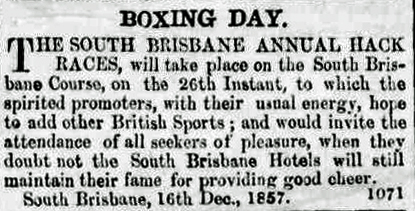
The race days were initially for hacks, or horses for everyday use, and not trained for racing. There were also novelty events, foot races, and entertainment. Crowds of over 1,000 were reported on many days, with people from North Brisbane venturing across the river, as well as many others arriving from nearby farming districts and from as far afield as Ipswich.
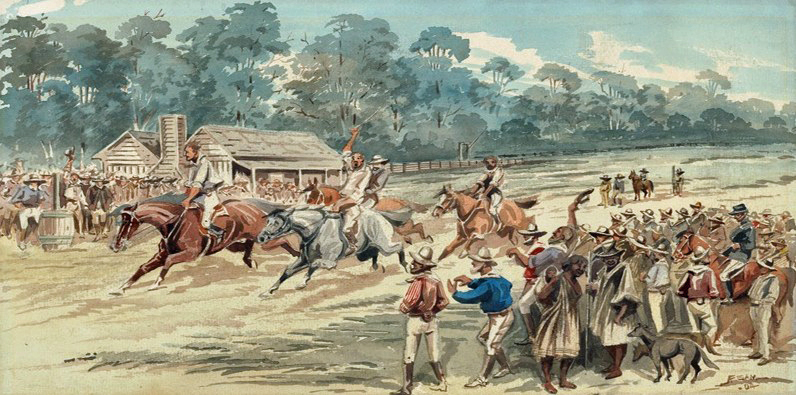
One common factor resonates through newspaper reports over the years. The track was terrible and totally unfit for purpose! Let’s look first at South Brisbane at the time.
Note: References to newspaper reports of particular race days in the text refer to those listed at the end of this post.
South Brisbane in the 1850s
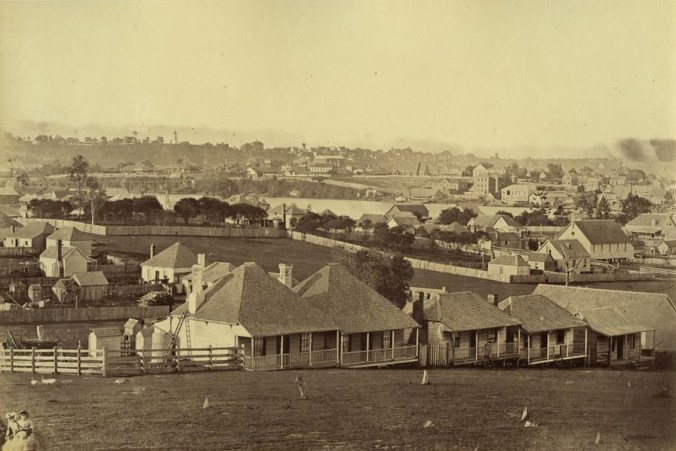
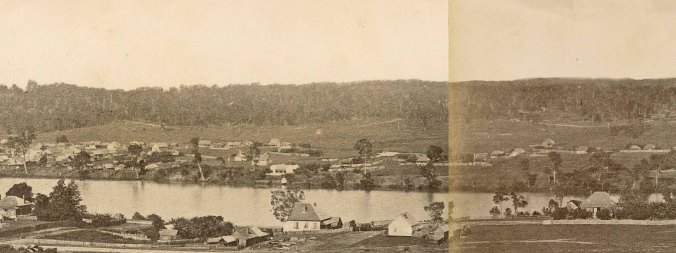
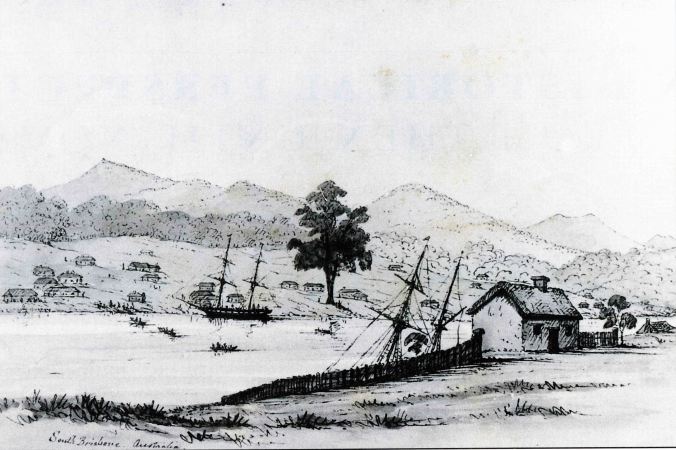
At the time the races were held, the village of South Brisbane occupied a few streets clustered along the river. There were primitive wharfs, boat builders, and commercial enterprises of various kinds meeting the needs of residents, visiting ships, and farmers from the surrounding districts. The 1856 census recorded just 926 European residents in South Brisbane and its environs.
The South Brisbane racecourses
Varying descriptions of the course, both contemporary and as recollected many years later, indicate that a number of different approaches were tried over the years. The organisers had some flexibility, as the land beyond Hope Street was cleared up to the tree line along Vulture and Boundary Streets, and was scarcely occupied. There were, however, many hillocks and gullies as well as a swamp to contend with.
The original course
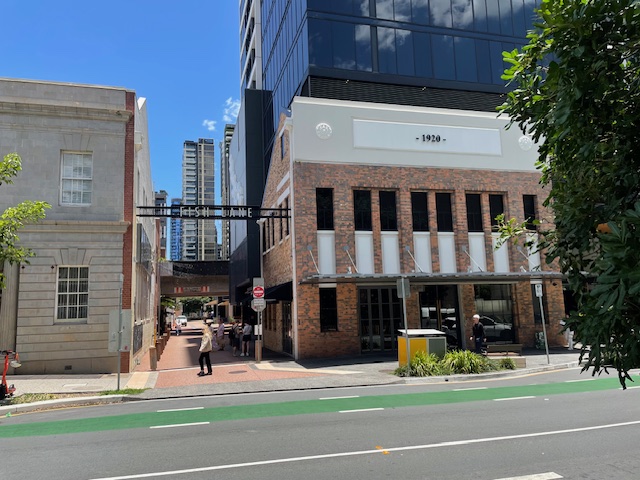
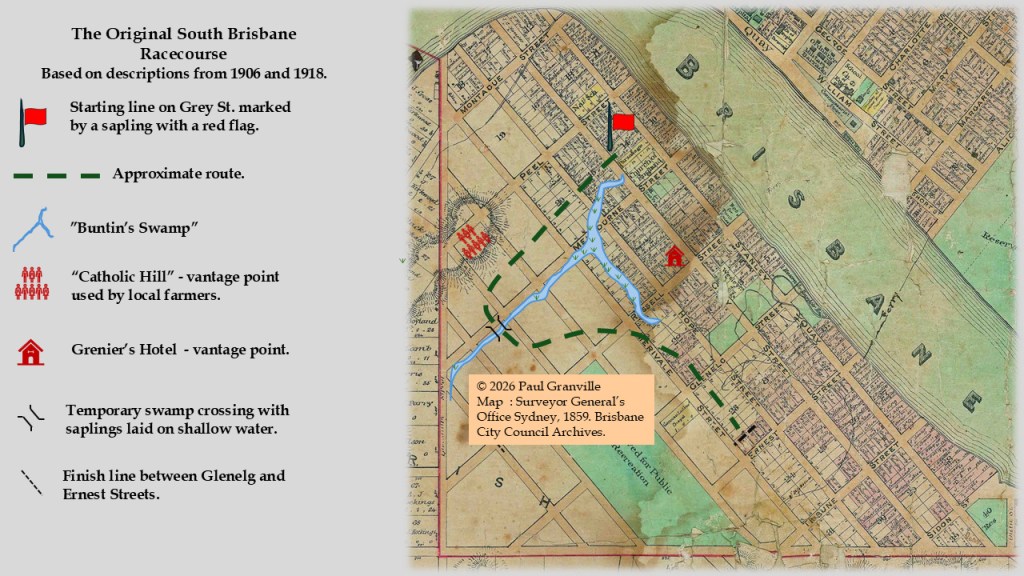
A detailed description of the course was published in 1906 and again in 1918. The similarity of the two descriptions indicates that they probably came from the same source. This route started on Grey Street near the site of today’s Fish Lane, initially skirting the northern side of the swamp that extended down Melbourne Street.
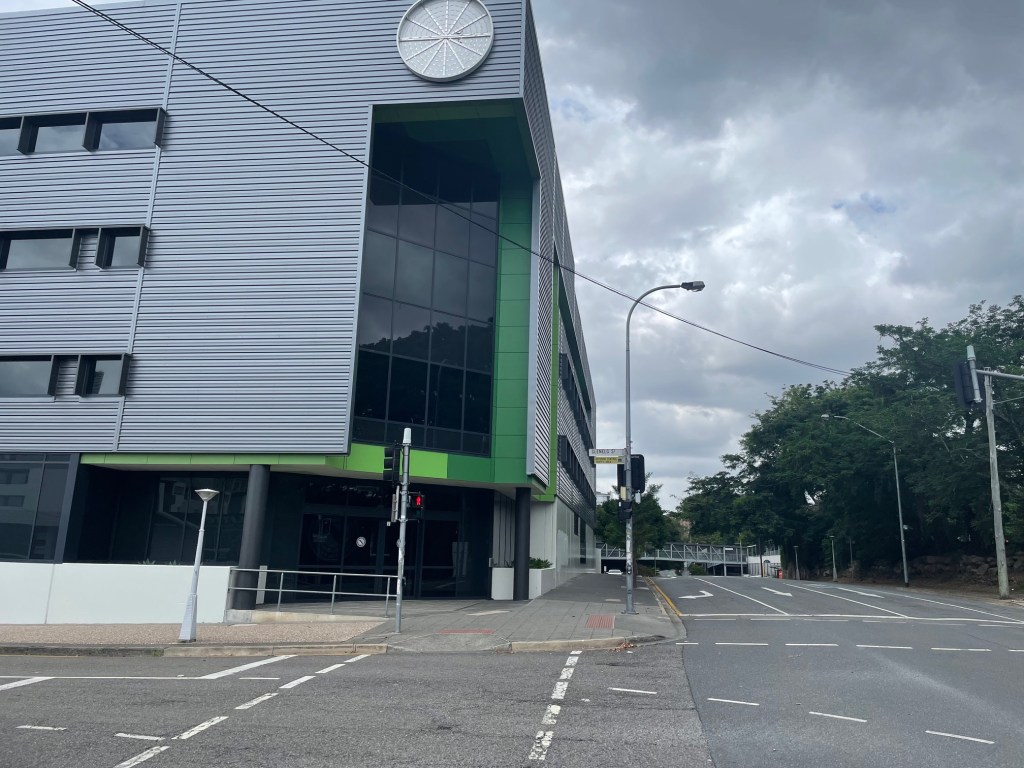
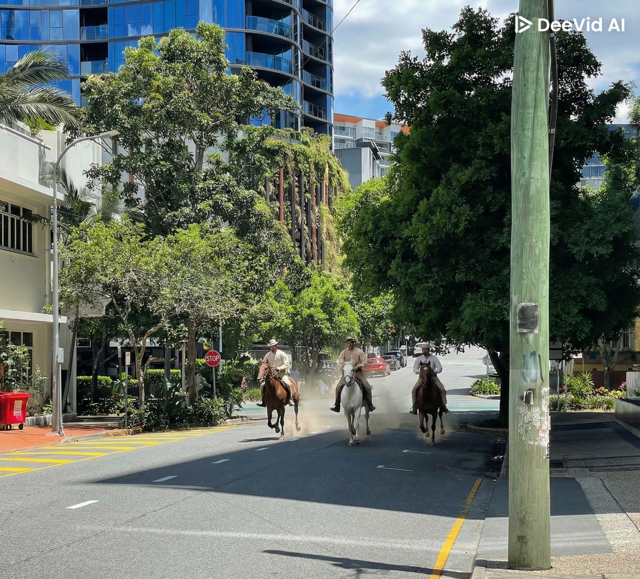
Horses crossed the swamp near Manning Street where the water was usually only about 8 cm. deep. Saplings laid across this narrow section of swamp assisted the horses to cross. They then swung left to avoid the rise in ground near Edmondson Street, crossing Cordelia and Russell Streets to finish the race galloping along what is now Merivale Street. The finish line was described as on the flat near the later location of the South Brisbane State School extension.
A newspaper report in 1861 commented on the poor course.
“Those who have examined the ground used for a course at South Brisbane, will agree with us, that three quarters of a mile of worse racing ground never was seen; and that it was high time steps were taken to put the public in possession of a racecourse on which there may be at least a reasonable chance for the avoidance of accidents.”
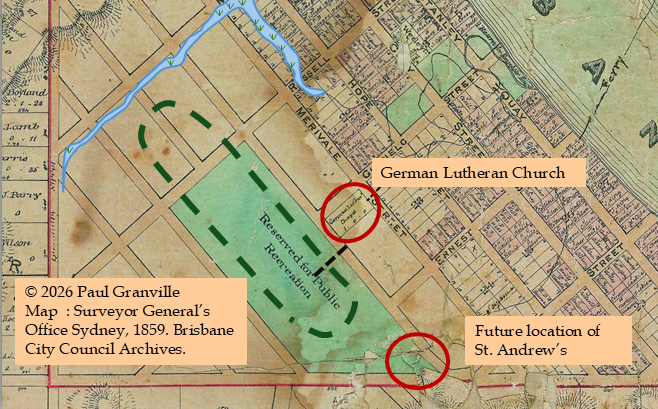
The length of ¾ mile quoted, approximately 1,200 metres, is close to that shown on the map below. In 1861, one horse is reported as finishing the course in 54 seconds, which suggests that some races were run over a shorter distance, perhaps starting south of the swamp.
The course in 1864 and 1865
Boxing Day in 1864 started with heavy rain, which cleared mid morning. The races were the main attraction in town that day.
“Thither all folks who had earlier mistrusted the weather wended their way from about ten o’clock in the forenoon, and at one period of the day there could not have been fewer than three thousand people on the hill around which the course was (by permission of the justices) marked out.”
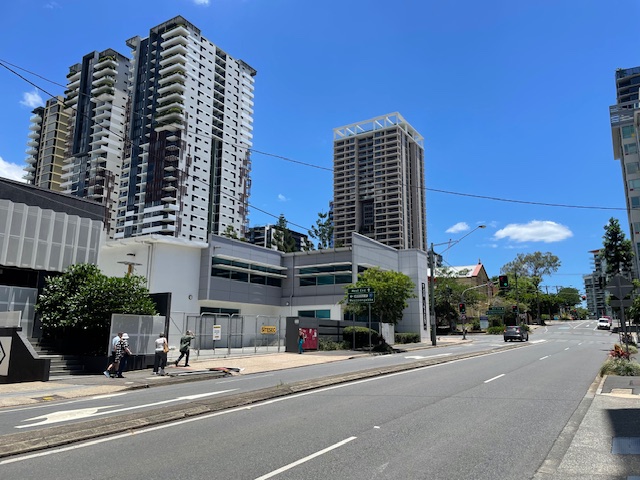
A report of the spring races held the next year in September states that it was run on the “old course” and would seem to be the same as in 1864, around a hill.
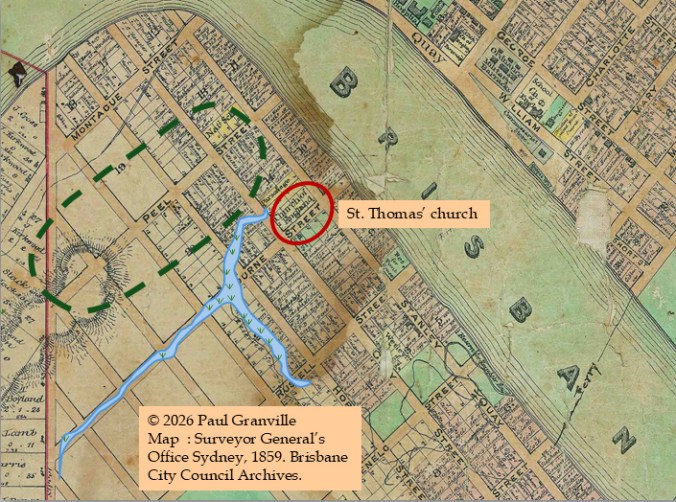
“The course chosen was round the hill adjacent to the English church, and certainly a more peculiar race course it would be difficult to imagine , as an opportunity was afforded to the horses of going up and down besides round it. There was not more than one hundred yards of level ground on the whole of the running, which consisted for the most part of a succession of little hills, with here and there a big one, additional advantages being derived from the fact that the steepest descents were on sidlings.”
The English church mentioned was Saint Thomas’, located at the river end of Melbourne Street where the Art Gallery is now located.
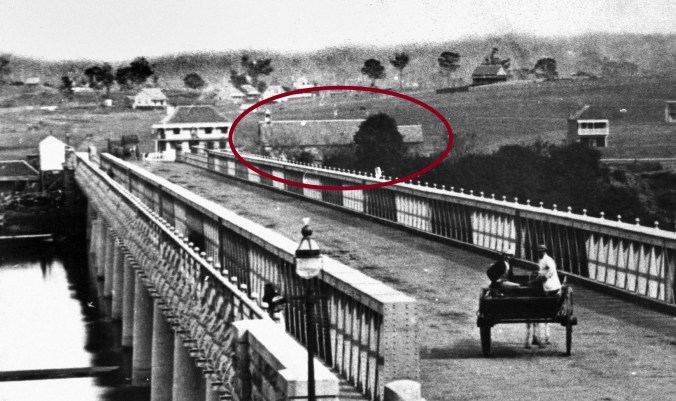
The only hill of substance nearby is the one that Peel Street now runs up, giving rise to the conjectured course map below. In 1864 and 1865, races were of 2 or 3 laps with the latter stretching around 2 miles, or a little over 3 kilometres, matching the illustrative track.
The Queensland Daily Guardian was not impressed by the course.
“The course is, without exception, the very worst that we ever saw. We are surprised that any man could ask another to ride a race on it —more surprised that owners of horses should permit their animals to gallop on such a ground, and still more surprised that any jockey could be rash enough to risk his neck there for any consideration.“
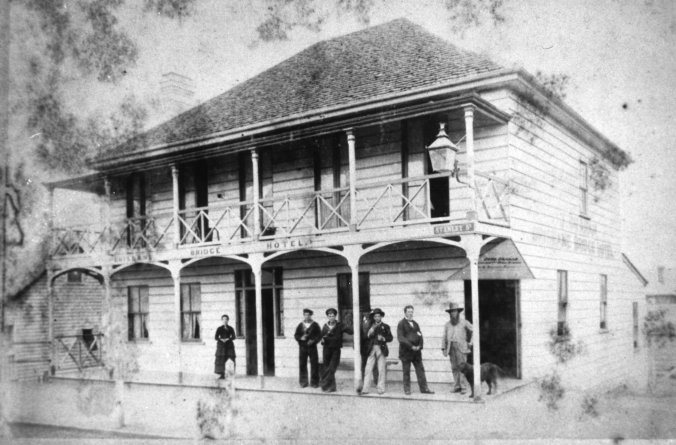
There are often mentions of falls over the years, but without injury. The undulating course contributed to an accident in the 1865 Maiden Plate, a race for horses that had never won a prize. On one of the descents, two horses collided, and one of them fell. The following horse, Jumper, with his jockey Burt, rolled over the fallen animal. Burt, described as “an unassuming young man and a first-rate horseman”, was carried insensible to the Bridge Hotel, where later he was reported to be recovering.
George Melton’s description
George Melton arrived in Brisbane as a 2 year old in 1853. Eighty years later, he recounted many detailed memories from his youth.

In 1934, he recalled that the races “started, and took a western turn where St. Andrew’s Church of England now is, and finished close to where the old German Church at Glenelg Street was.” He was possibly recalling the later races in the 1870s with multiple laps, and his recollection suggests the positioning below. The track would not have been too close to the location of St. Andrew’s, as there is a very steep gully near Ernest Street. This is the most speculative of the three courses described, as the description is so brief.
Race days
Each race day was organised by a volunteer committee whose members also served in roles such as judge, starter and steward. Donations from interested parties went towards the prizes. There was often a “Publicans’ Purse” race, no doubt subsidised by local hoteliers who greatly benefited from these events. An entry fee for each horse helped finance the day.
As can be seen from the list of newspaper reports that I have located, most races were held on New Year’s Day or Boxing Day, which were both public holidays. Being in summer, the racing at times took place in heavy rain, or on a wet, boggy track, with the swamp swollen in size. A few race days were held on other “bank holidays” such as the Queen’s Birthday and Separation Day. Saturday races attracted a much smaller crowd, as it was a working day for most.
Newspaper estimates of attendance over the years ranged from just 200 to 3,000, but around 1,000 was the norm. Many crossed the river from North Brisbane by one of the small row boats that served as ferries.
There was also a good attendance from suburban areas and nearby farming districts such as the Logan, Albert and Coopers Plains. A report from 1873 observed that
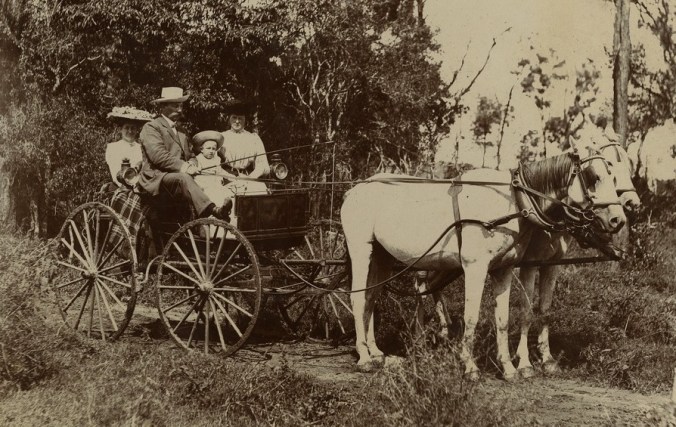
“long before the appointed hour for the first race, the clouds of dust shooting right up into the sky from Stanley and Grey Streets heralded the approach of the drags (horse-drawn vehicles) from the One-mile Swamp (Woolloongabba) and Kangaroo Point, as also from over Armstrong’s and Baxter’s ferries…. It was impossible to distinguish horses, carriages, or occupants— and your correspondent was in the thick of it.”
The pubs were open all day except on Sunday and did a roaring trade. A report from 1858 listed some of the public houses.
“Load after load of pleasure-seekers were taken to the classic shore of the south, to enjoy themselves on the green sward, take a nobbler at McIntyre’s (the Royal) , or pass the pledge of a merry Christmas at Souter’s (the Commercial ), jog over to Mooney’s ( the Prince Albert), and then brace the nerves for a clearer before the races at Mrs. Greenwood’s (the Brisbane, commonly known as Grenier’s).”
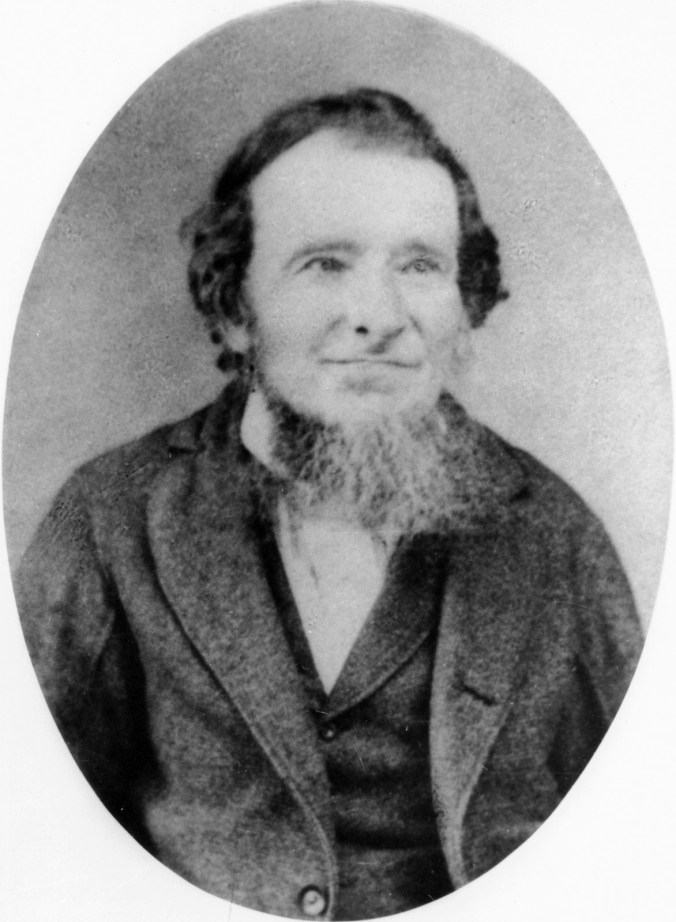
Tom Grenier was a well known character who had become the publican at the Brisbane Hotel, located near the corner of Russell and Grey Streets, in 1852. He was a big supporter of the races, often entering his horses. In 1858, the licence passed to recently widowed Mary Greenwood, who was his son’s mother-in-law, and an experienced publican.
The pub was located on a rise from where there was a view of the horses after they had passed the swamp. This, along with the proximity to the bar, made it a popular spot for spectators to gather. Another was on the ridge where Peel Street now runs, then commonly known as “Catholic’s Hill” due to the location of St. Mary’s church at the peak. Under a large shady tree, farmers from along Montague Road and Hill End gathered to watch the races.
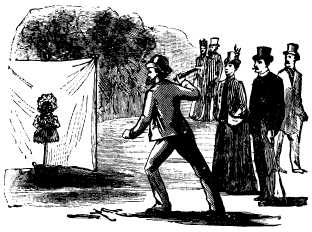
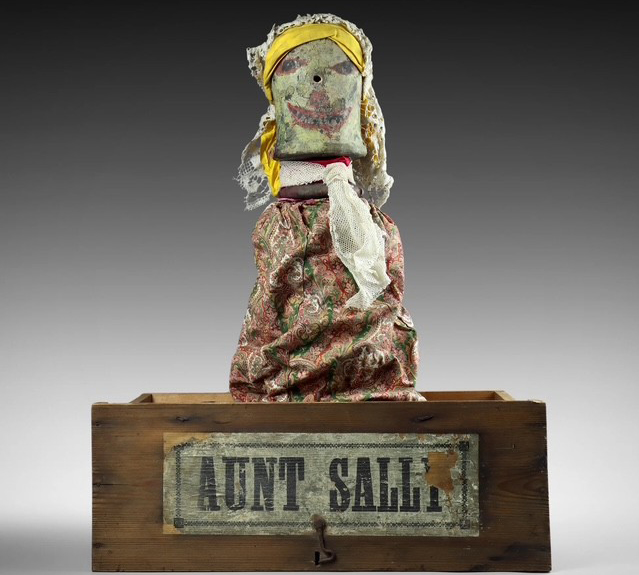
Mary Greenwood also did the catering, and set up stalls near the most popular viewing spots. Sellers of fruit and lollipops wandered around the crowd. The 1863 report mentions “six sticks for sixpence, Aunt Sally, and similar games for facilitating the disbursement of superfluous pence, being much indulged in.”
“Aunt Sally” is an old English pub and fair game where players had to knock a figure off the top of a pole using wooden sticks. “Six sticks for sixpence” players threw a bunch of sticks into the air and won a prize if enough sticks landed with the marked side up.
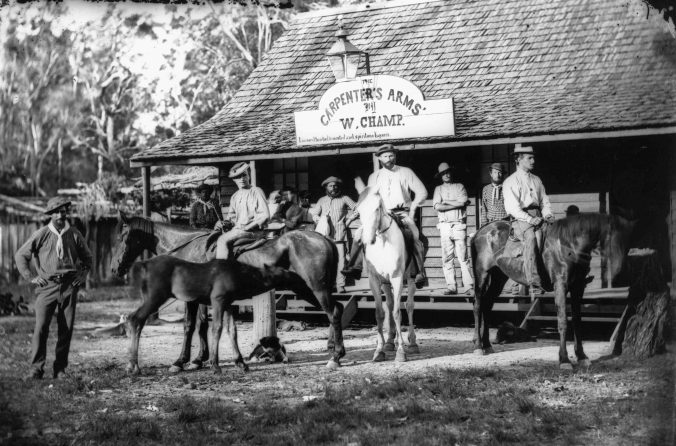
It was an occasion to dress up. The 1918 reminiscnce talked of young stockmen who were
“in the slang of the period, ‘got up to kill’ – knee breeches, well-shined Wellington boots, nicely wrinkled at the ankles , bright spurs, cane handled whip, cabbage-tree hat, and long coloured sash with tasselled ends. This sash circled the waist three or four times, and the ends were tucked in at the hips“.
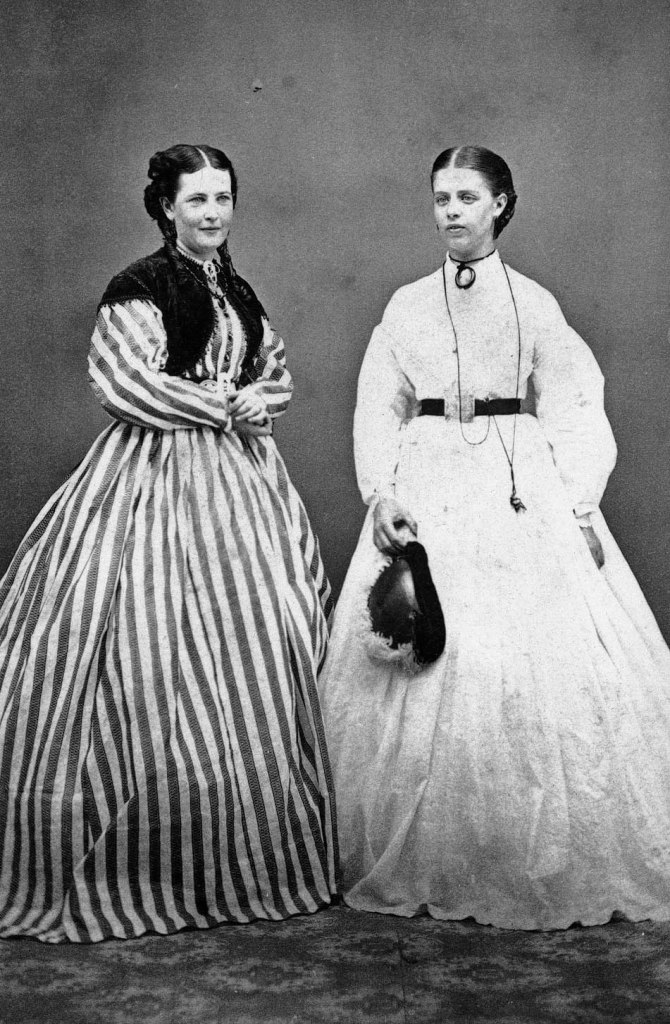
The author of an article on the 1873 races had this enigmatic comment on women’s fashion.
Being an old bachelor, it is not my province to speak of the ladies’ dresses, but I really cannot help remarking that stone colored – with the blue — well
“True modesty is a discovering grace.
And only blushes in its proper place.”
Most newspaper reports of race days described a quiet, well-behaved crowd, with only occasional fights between racegoers who had excessively imbibed disturbing the festivities. Occasionally, high spirits were evident, such as in 1864 when racegoers had a little extra entertainment.
“Some fun was occasioned by two individuals who, in spite of the remonstrances of the bystanders, persisted in racing through a small lagoon near the course and of course coming out dripping like water dogs, but beyond that the proceedings were not very lively.“
Races
Around 6 races were held with prize money varying by year and race, but typically in the range of £5-£15. Occasionally, there was a donated non-monetary prize, such as a saddle and harness. The races were initially non-professional, and there were female and First Nations riders.
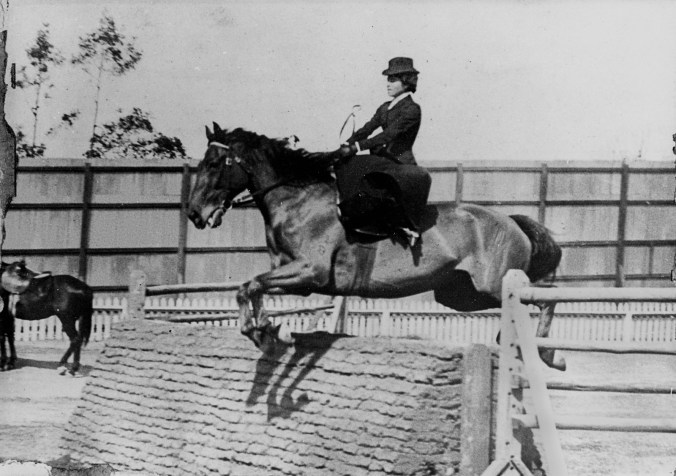
From the early 1860s, there were more trained horses racing. Prominent, for example, was horse owner, trainer and jockey Larry Flannery, who often entered multiple horses at South Brisbane and at other meetings. He created a kerfuffle at the 1863 races when his horse Tarquin was disqualified for going the wrong way around a post. Higher prize money began to be offered, reaching £30 for the “Brisbane Bridge Grand Handicap” in 1865. There were 6 starters, and the race was won by Henry Skyring’s Don Juan.
Most races comprised 3 heats, but with the same horses in each heat unless one dropped out. A single horse had to win multiple heats to be declared the overall winner. As few as 2 or 3 horses entered some races, but this still provided great entertainment for the crowd and kept the bookies busy. Included from time to time were hurdles races, displays of jumping, and cart horse races.
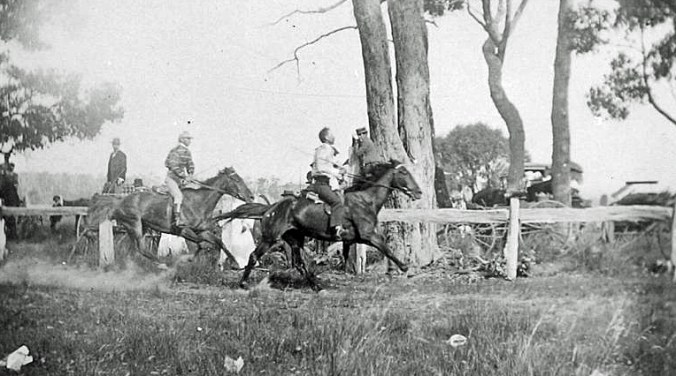
Meetings usually finished with the popular Hurry Scurry, which consisted of low jumps and sharp turns requiring agility and speed. An added attraction through the day was the inclusion of foot races and “sports of an amusing kind” such as sack and wheelbarrow races. With a full program, at times the last event didn’t finish until sunset.
The last races
The Brisbane races fell into abeyance after 1865, perhaps not coincidentally the year when the Queensland Turf Club began races at Ascot. A group of South Brisbane enthusiasts revived the races in 1873 and 1874. The organising committee included such well known people as the auctioneer John Cameron, who served as secretary. On race day, he also had the unenviable job of handling the finances, and he “performed those delicate duties with his accustomed tact and ability”.
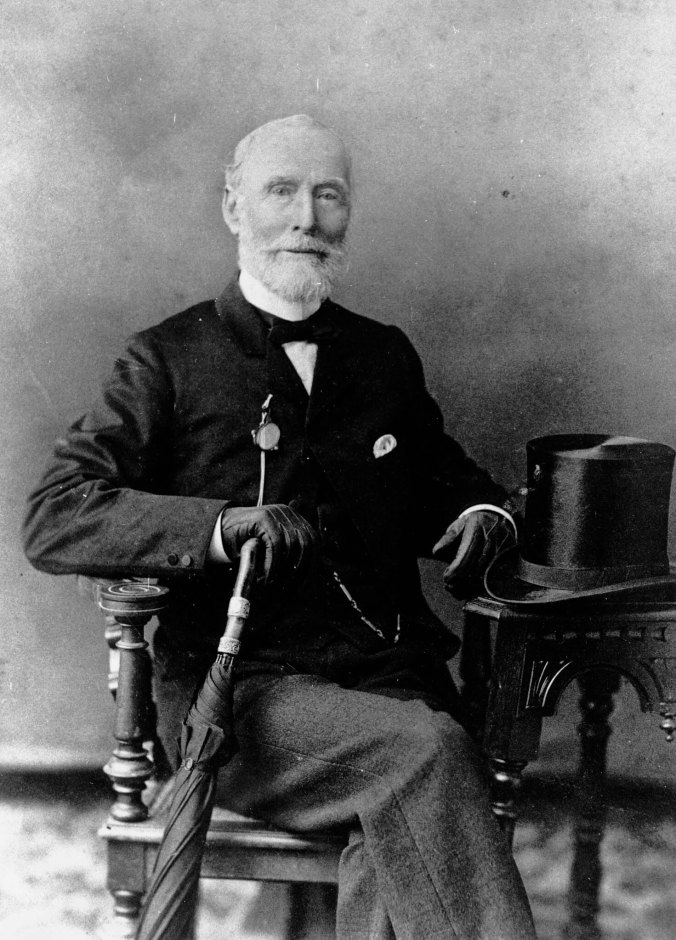
It’s probable that the course alluded to by Melton was used. The first race day in 1873 was on Easter Monday, and it attracted a crowd of over 1,000. The second was held on Separation Day, a public holiday that commemorated the founding of Queensland. This was a much smaller affair with just a few hundred attendees.
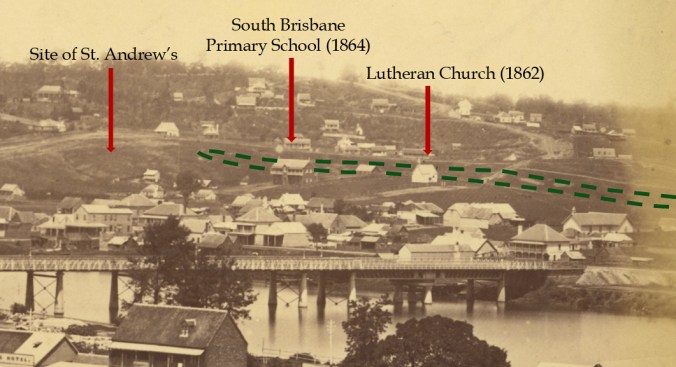
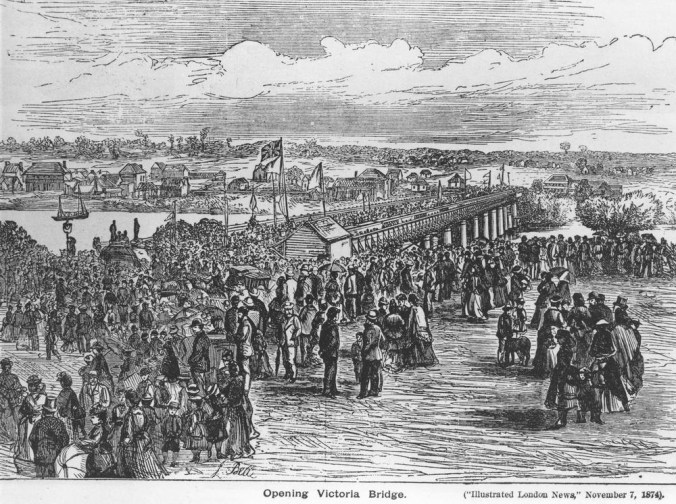
The final races were held on a special public holiday in 1874, when the Victoria Bridge, after 10 years of disaster and delay, was finally opened.
By this time, a more professional approach was being taken, with jockeys in costumes and a separate race for hacks.
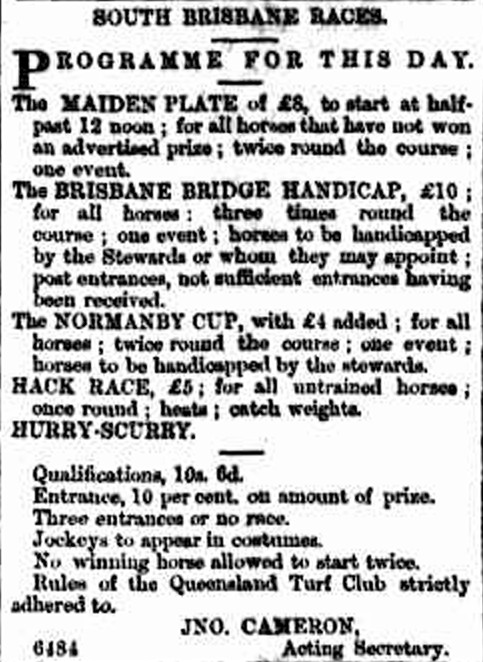
Despite the waving of the normal bridge toll of a penny for foot goers and a shilling for one-horse buggies, only about 200 attended. The races were competing with a grand parade and other festivities. It was to be the last South Brisbane race meeting.
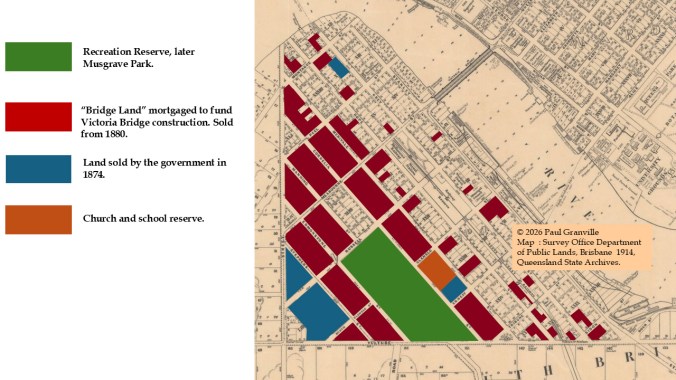
Almost all the land traversed by races over the years was either part of the recreation reserve or “Bridge Lands”. In 1883, the recreation reserve trustees belatedly received the title deeds, and the land was fenced and renamed Musgrave Park (my post Musgrave Park – The Early Days gives the full story). The Bridge Lands had been mortgaged in 1864 to fund the construction of the Victoria Bridge. From 1880, this land was finally auctioned and subsequently developed (see my post The Fascinating Story of the First Victoria Bridge). The open fields had gone, and the South Brisbane Races went with them.
Appendix – newspaper reports of race days
These are the newspaper reports of race days that I have located to date. There are likely to be others yet to be discovered.
© 2026 Paul Granville
 Highgate Hill and Its History
Hi all FYI Maybe the Socrates Tuesday lunch group have a duty to emulate past practice? As follows “Load after load of pleasure-seekers were taken to the classic shore of the south, to enjoy themselves on the green sward, take a nobbler at McIntyre’s (the Royal) , or pass the pledge of a merry Christmas at Souter’s (the Commercial ), jog over to Mooney’s ( the Prince Albert), and then brace the nerves for a clearer before the races at Mrs. Greenwood’s (the Brisbane, commonly known as Grenier’s).” Regards, Frank New
LikeLike
Thankyou so much Paul for all the information you’ve sent about the early days, so interesting to read it all, I just love it to bits. You know so much, very clever of you to put it all together and also very kind of you to spread it around with others.
Kind regards, Pamela Ford ________________________________
LikeLiked by 1 person
Thanks very much Pamela. It’s great to hear that you appreciate my work.
LikeLike