Water Problems in Highgate Hill
Shortage of water was initially a major inhibitor to the residential development of Highgate Hill. In a 1930 article in the Courier Mail describing the history of the suburb, the water issue merits its own section. It describes how early residents made brick lined underwater tanks to collect rain water, and fetched water from water holes along Gladstone Road or from the spring which existed at the site of the Boundary Hotel. The 1930 article mentions that amongst early settlers was the Wilson family who built a home at the top of Bellevue Street in the 1860s.
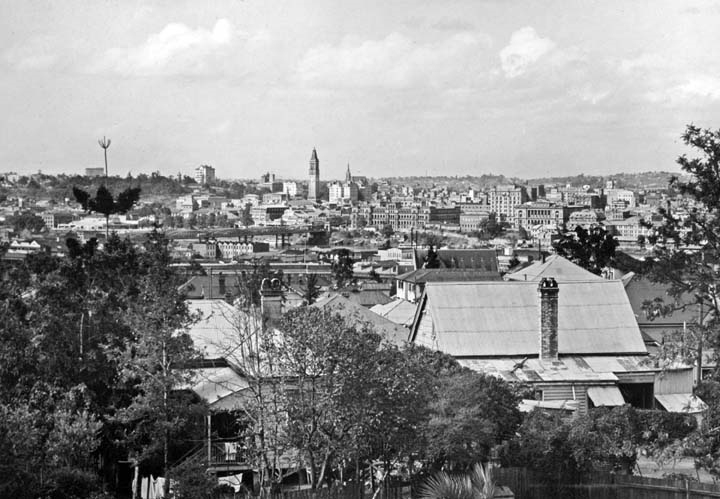
One of their children, later the well known architect Alexander Brown Wilson (see my post Alexander Brown Wilson, Architect.), recollected fetching water.
‘Mr. A. B. Wilson distinctly remembers his mother and a Highland lassie named Katie Campbell, who accompanied the Wilsons to the new land, as well as other members of the household, troop to the spring in Boundary-street with buckets, tubs, or any other handy container, and trudge back through paddocks, over gullies, and through bush with the precious water.’
Another article in the Courier in 1930 described West End. It mentions that a creek ran down from the vicinity of Dornoch Terrace to Melbourne Street. A reservoir was built on the creek at the corner of Melbourne and Manning Streets from where, after rain, water was sold by the cask. For more on the topic of water in the area see my post Kurilpa – Water, Water, Everywhere.
Some householders built underground water tanks lined in bricks. Here’s one in Highgate Hill that the Lang family partially excavated in their yard. With evaporative cooling, these were also used to store perishables such as butter.

Later, when corrugated iron became available, water tanks made with this material were very popular and were still common in Brisbane backyards in the 1960s. Water was also supplied by horse drawn dray. The cost of this supply was 20 shillings (approximately $130 in 2015 dollars) per 1,000 gallons compared to the cost after reticulation of 3 pence (around $1.60) per 1,000 gallons.(Cameron 1989). For more on water issues, see my post Kurilpa – Water, Water, Everywhere.
Brisbane’s early water supply
Brisbane’s first water supply was from a dam across the creek which flowed from around the Wickham Terrace area down to the river at Creek Street. The dam was close to the location of today’s Supreme Court.

By the mid 1860s, this was completely inadequate and Enoggera Dam was completed in 1868. At the time, it was one of the largest dams in Australia.
The first permanent Victoria Bridge was completed in 1874 (see my post The Fascinating Story of the First Victoria Bridge)and a 6 inch (approximately 15cm) water pipe was extended over the bridge in 1877, replacing a pipe laid on the river bed that was frequently damaged by ship anchors. This was later supplemented by a 9 inch (around 23 cm) pipe. Whilst a reticulation network was constructed, the pressure was insufficient to provide a satisfactory service for many locations. Also, until 1885, the pipe was disconnected when the bridge swung open from time to time to allow ships to pass, resulting in an interruption of supply.

The new reservoir
With the growing population of the South Brisbane district, the decision was made to build a service reservoir at a suitable high location. Highgate Hill was perfect for the job. The reservoir was to be fed from Gold Creek dam near Brookfield. This dam was built in 1886 to supplement the existing reservoir at Enoggera during the period of a great drought that impacted Eastern Australia from 1880 to mid 1889.
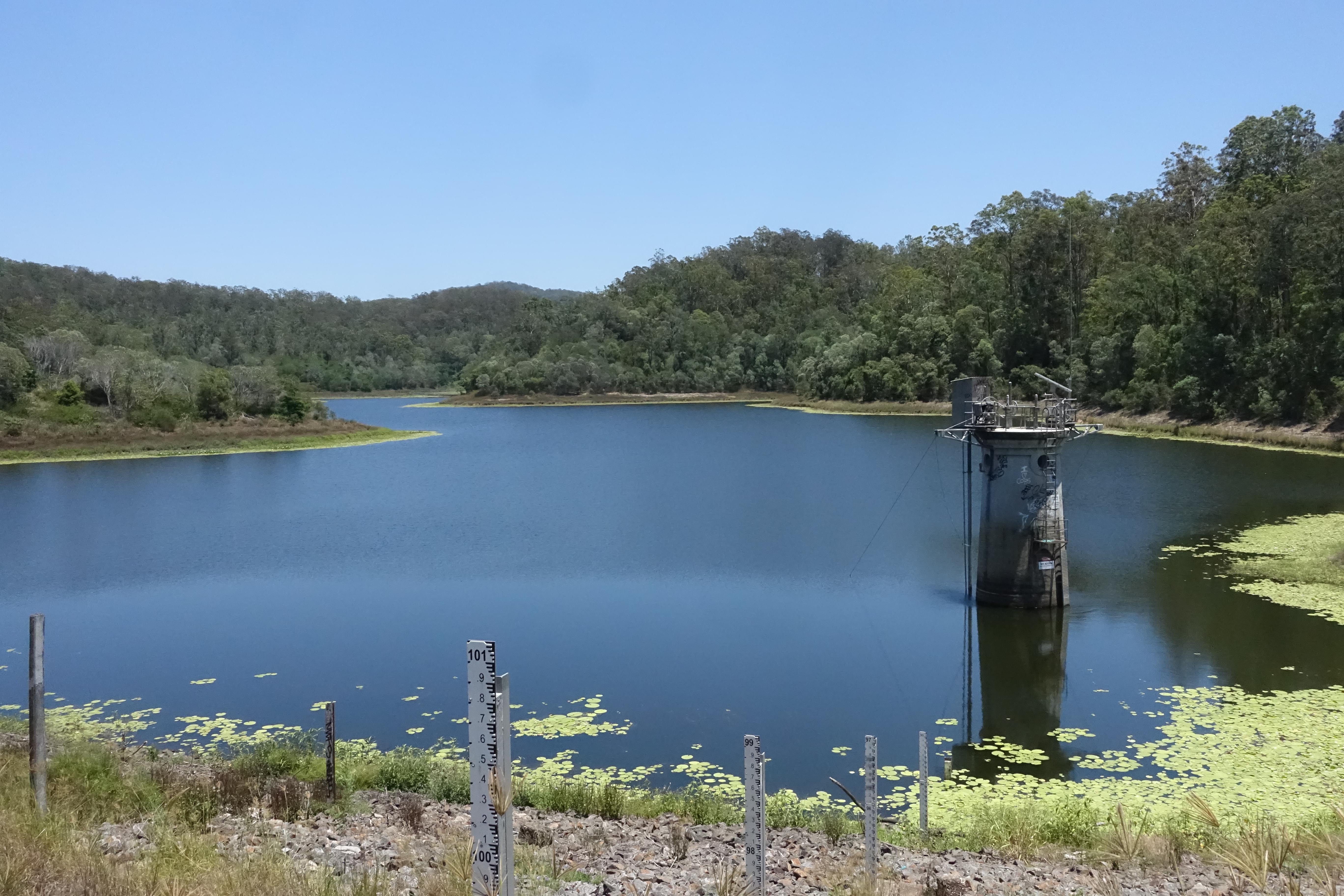
The stepped spillway was the first of its type in the world.

A pipeline was built from Gold Creek, passing under the river at Toowong, and then up Ferry Road, Drake, Hoogley and Ganges Streets and Dornoch Terrace to the reservoir location.
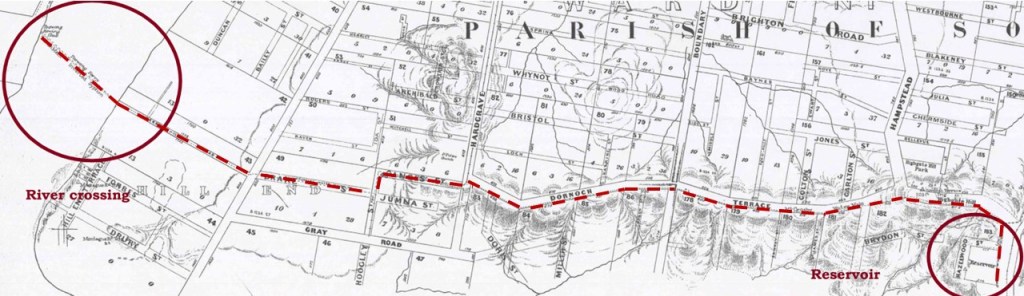
Under the river, a 16 inch (400 mm) pipe with ball joints was used to deal with the irregular river bottom.
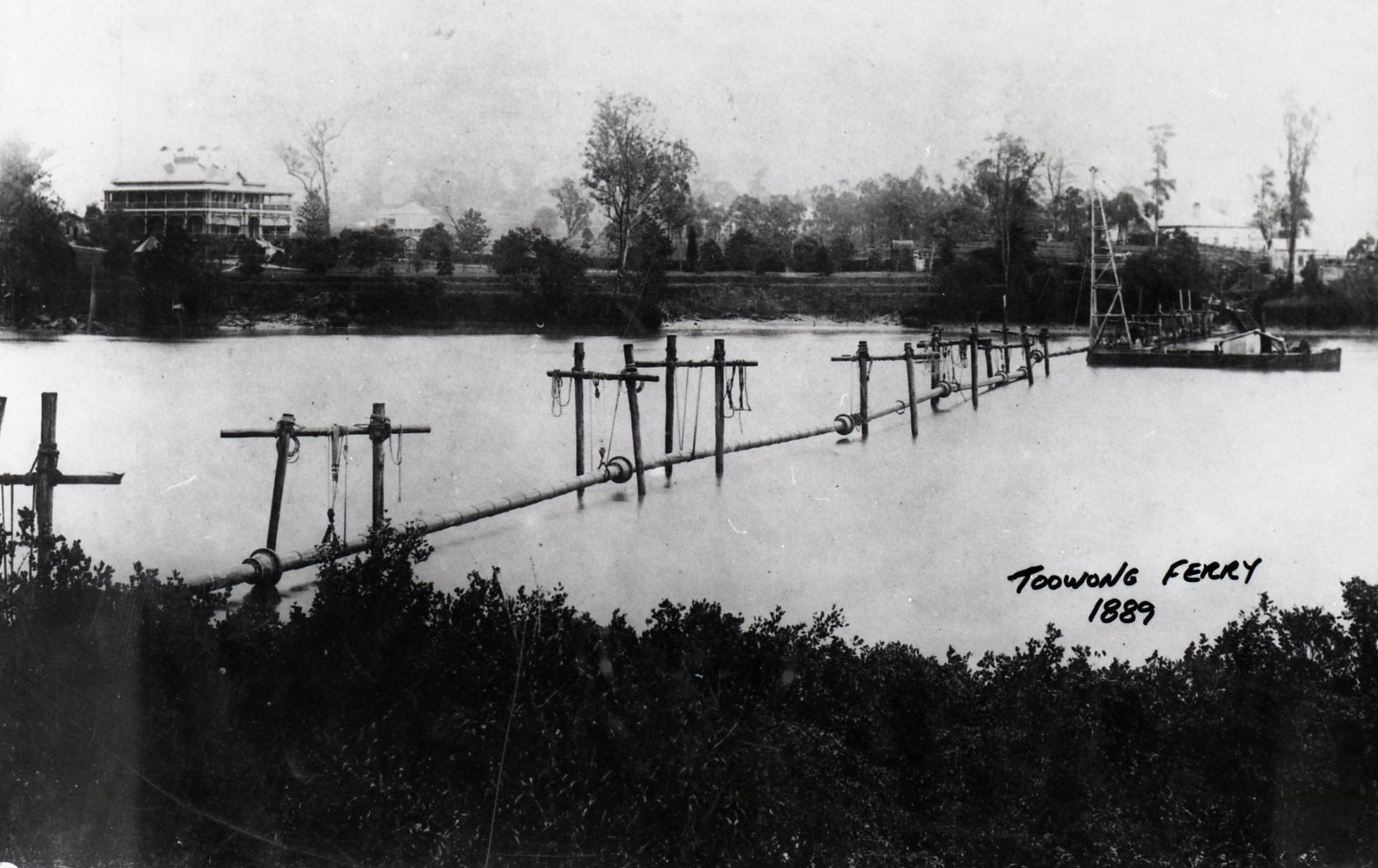
From the river crossing a 12 inch (300mm) cast iron pipe was used.

The Highgate Hill reservoir is located on Gladstone Road, close to the corner of Dornoch Terrace and adjacent to Hazelwood Street, mentioned in a previous post, The Hazelwood Estate, Highgate Hill 1885.
Gold Creek Dam is approximately 96 metres above sea level, 24 metres higher than Enoggera Dam. Water reached the Highgate Hill reservoir at around 60 metres above sea level via a syphon effect. As well as the gravity feed to the Highgate Hill reservoir, there was also a tunnel connecting the dam with that at Enoggera. Gold Creek dam was decommissioned in 1991.

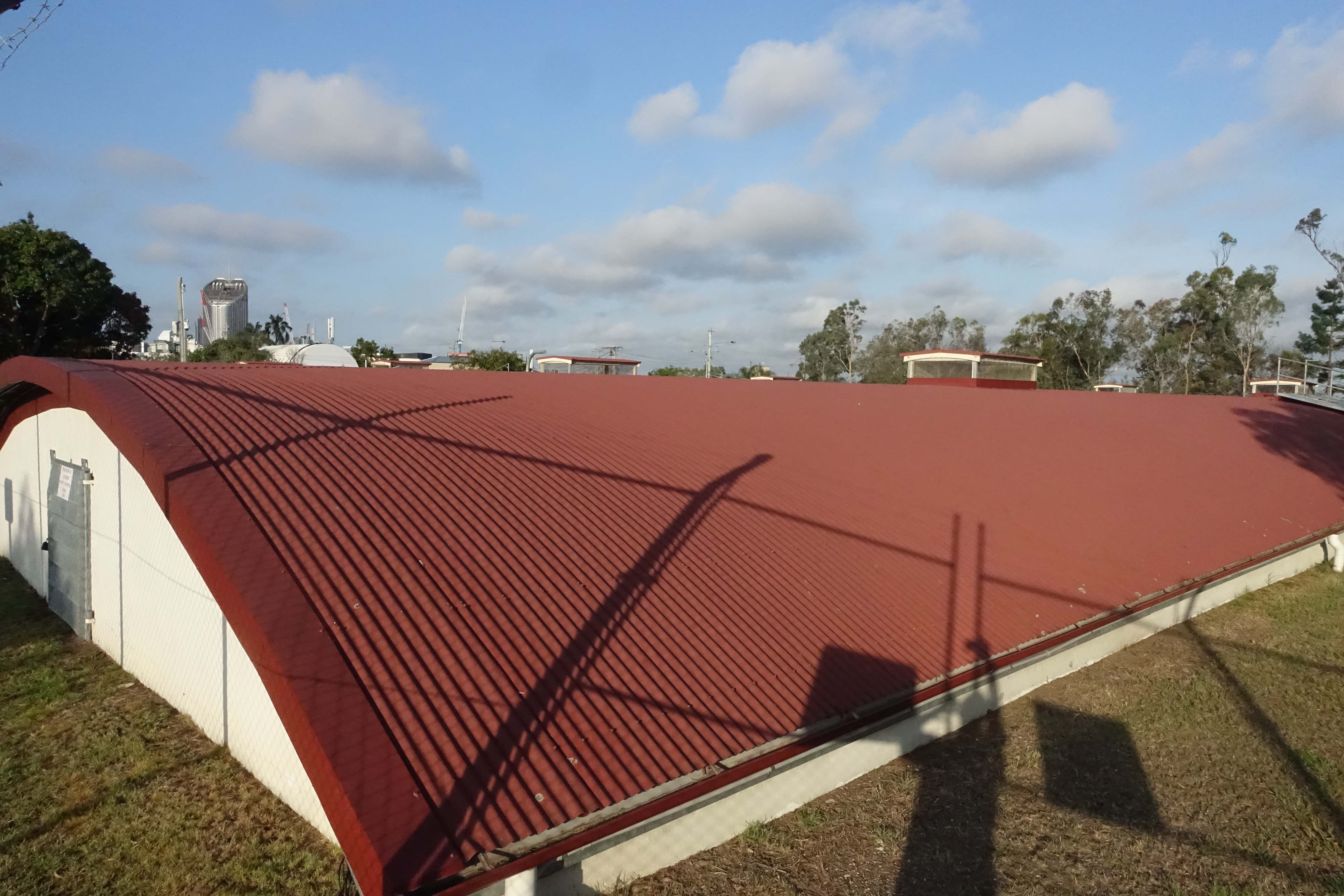
In December of 1888, the contract to construct the reservoir was awarded to Henry Hudd. His price of £13,434 15s. 6d. was not the lowest, but he undertook to complete the work in eight months, which was six months less than the time offered by the lowest tenderer.
As it transpired, the work was completed in 10 months and was extensively reported in the press. The reservoir fed a large area including Kangaroo Point, East Brisbane, West End and South Brisbane.
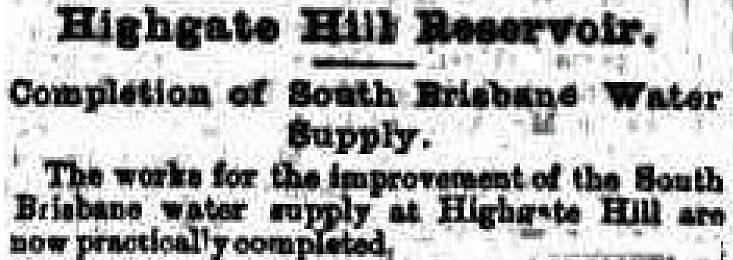
The full article may be read in TROVE
The lack of reticulated water had made house fires particularly dangerous. A previous post in this blog, Rat Causes Fire on Highgate Hill 1887 gives a typical example of the difficulty of fire fighting with closely spaced wooden houses. Great importance was placed on the role of the new reservoir with respect to fire fighting.
This article dates from 4 years after the reservoir was completed.

The telephone was an expensive item at that time. For a discussion on the introduction of telephones, see my post The Telephone Becomes Automatic . An example of the need for one at the reservoir was when a fire broke out at Heaslop’s store in Stanley Street, Wolloongabba in 1909 and the fire brigade had insufficient water to fight the fire.
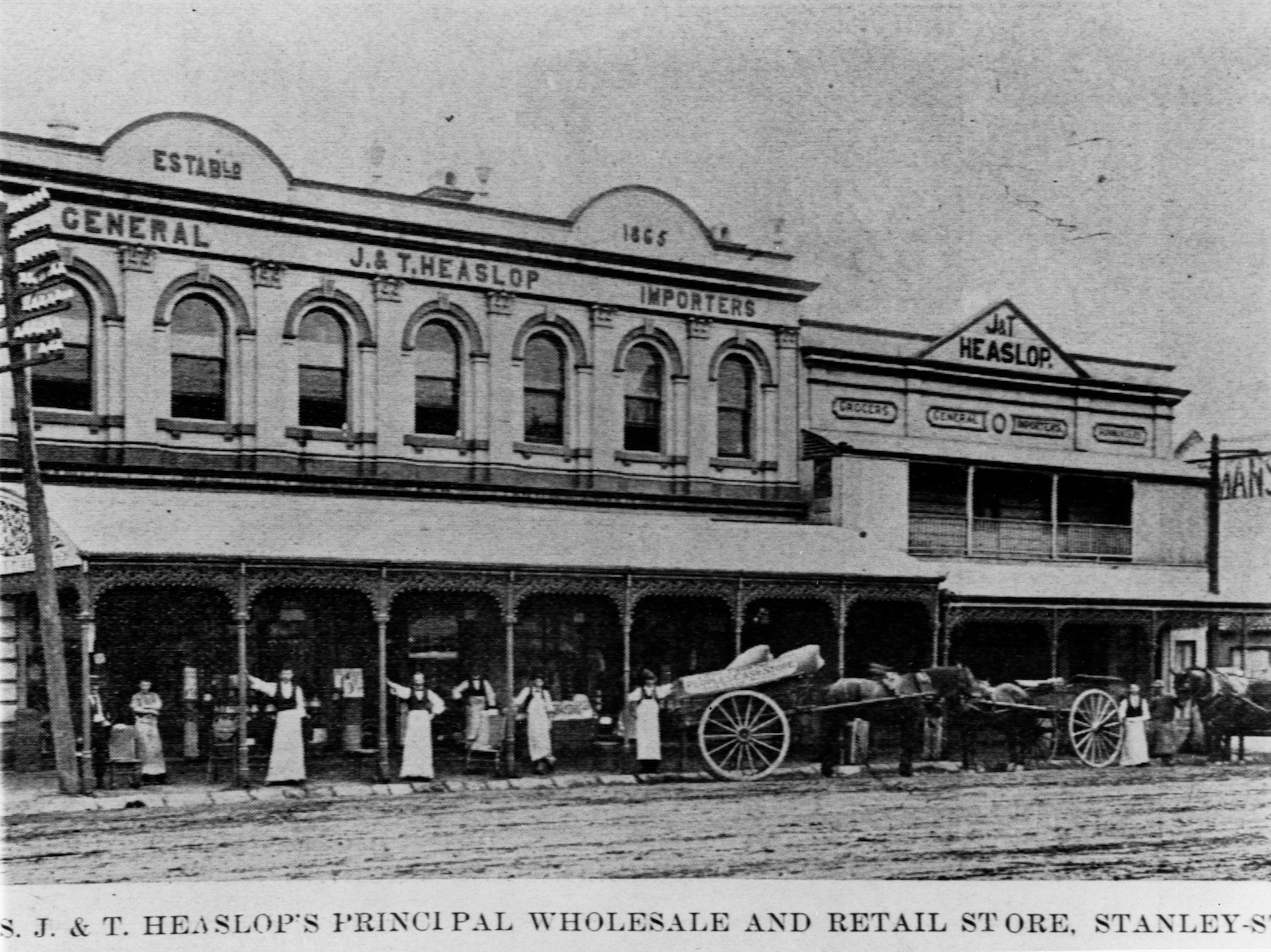
After he was contacted, the turncock at Highgate Hill increased the water supply, but 15 minutes passed before the pressure increased at Wolloongabba, and the building was completely destroyed. The Fire Brigade claimed that water pressure on the northside was usually around 100 pounds per square inch (700 Kilopascals), whilst it was commonly only half that on the southside.
Despite these works, subsequent extension of water reticulation to a given home was not automatic. For example, there is mention in the Telegraph, 30th August 1916 of an application to Council for extension of water supply to Fraser Terrace and to Dudley and Sankey Streets.
Highgate Hill service reservoir remains in operation today.
For further reading on Brisbane’s water supply please see this blog from the State Library
References
Highgate Hill. (1930, November 22). The Brisbane Courier (Qld. : 1864 – 1933), p. 19. Retrieved December 3, 2016, from http://nla.gov.au/nla.news-article21606866
Growth of a Garden Suburb. (1930, November 8). The Brisbane Courier (Qld. : 1864 – 1933), p. 19. Retrieved March 24, 2017, from http://nla.gov.au/nla.news-article21602186
Cameron, Ian (1989) 125 Years of State Public Works Brisbane Boolarong Publication
© P. Granville 2016 – 2020
 Highgate Hill and Its History
Pingback: Rat Causes Fire on Highgate Hill 1887 | Highgate Hill and Its History
Pingback: Glenview – A Highgate Hill House circa 1883 | Highgate Hill and Its History
Pingback: The Blakeneys of Highgate Hill | Highgate Hill and Its History
Pingback: The Telephone Becomes Automatic | Highgate Hill and Its History
Pingback: The Hazelwood Estate, Highgate Hill 1885 | Highgate Hill and Its History
Pingback: Kurilpa – Water, Water, Everywhere | Highgate Hill and Its History