The corner of Boundary and Vulture Streets in West End has been a centre of local commerce since the 1880s. This post traces the history of the intersection and of the people who had their businesses there.
The origin of Vulture and Boundary Streets
The area around the location of the intersection was swampy land forming part of the Kurilpa hunting grounds of the Turrbal and Jagera people. Close by was a habitual camping site along a ridge leading down to today’s Musgrave Park.
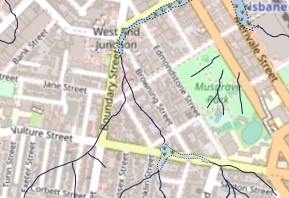
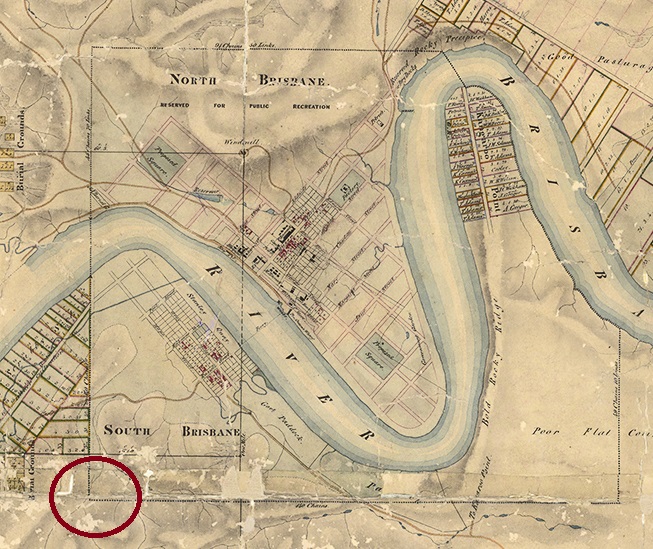
In 1842, 18 years after a convict settlement was established by the British Government, Moreton Bay was opened to free European settlement. Surveyors prepared for land sales and determined the town boundaries, located well out in the bush to allow for growth. The future West End intersection was the south-west corner of the town boundary.
By the 1850s, Brisbane had started to grow out towards the boundaries, which had become rough tracks. It was around this time that police started to force Aboriginal people to withdraw beyond the boundaries after nightfall and on Sundays. The rough tracks gradually transformed into gravel roads. For a description of how the roads themselves developed, see my post Vulture Street – From Dotted Line to Bitumen.
The four corners
From the 1880s, with rapid urbanisation of the West End and Highgate Hill areas, the need for supporting services likewise increased. Butchers, bakers, and boot makers, tailors, tobacconists and tea rooms, drapers and dressmakers, fruiterers and fishmongers were soon clustered along Boundary Road and around the intersection with Vulture Street.
Let’s look at the history of each of the four corners of this intersection in turn.
201 Boundary Street, the north-west corner
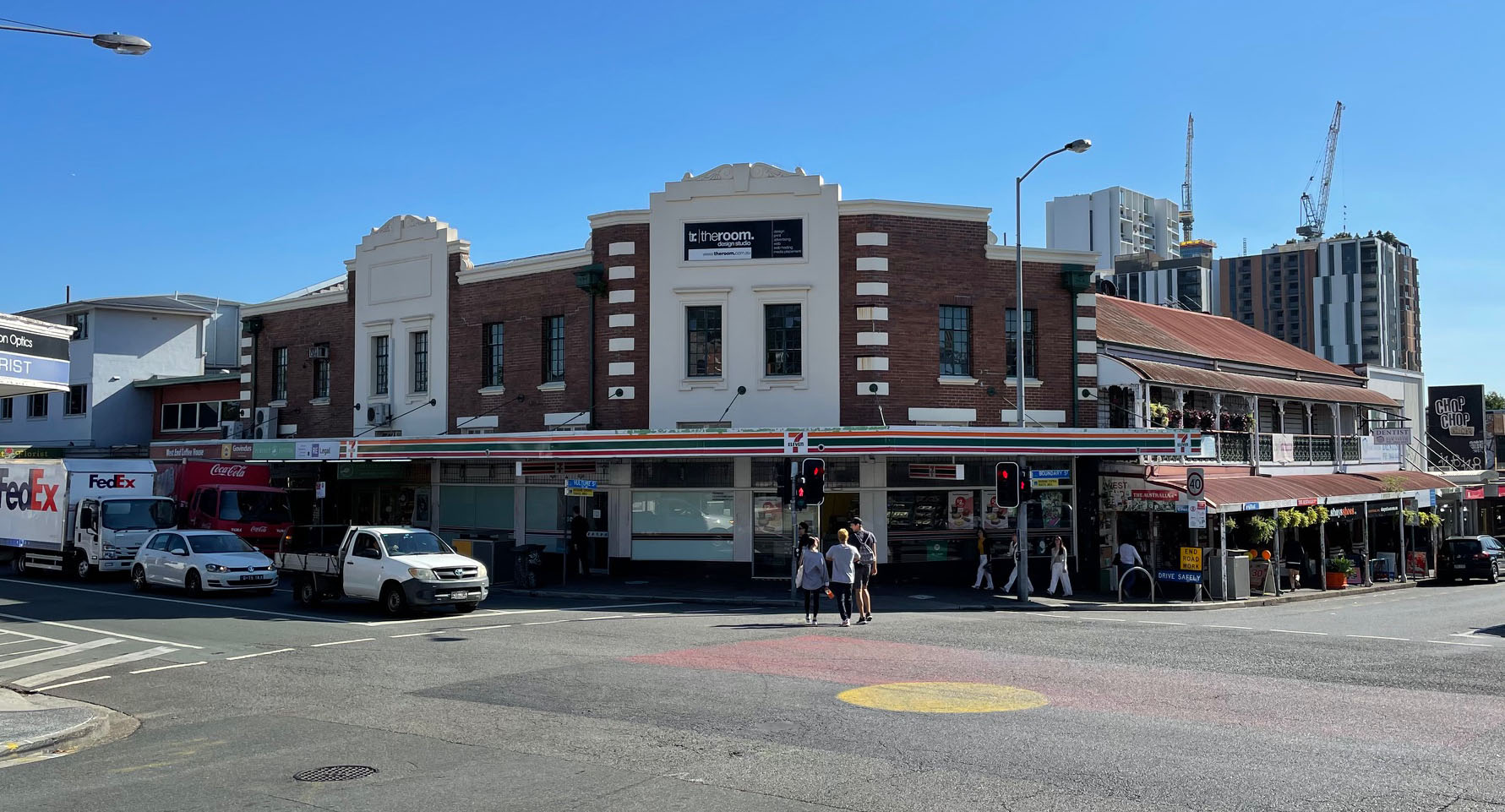
From around 1885 until 1925, a single story building stood on this corner. Over the years, this housed a variety of businesses including a bakery, grocery store, and from 1896 the Pastoral Butchery Company. It remained a butchers until 1919, when Lee Hop opened his fruit shop.
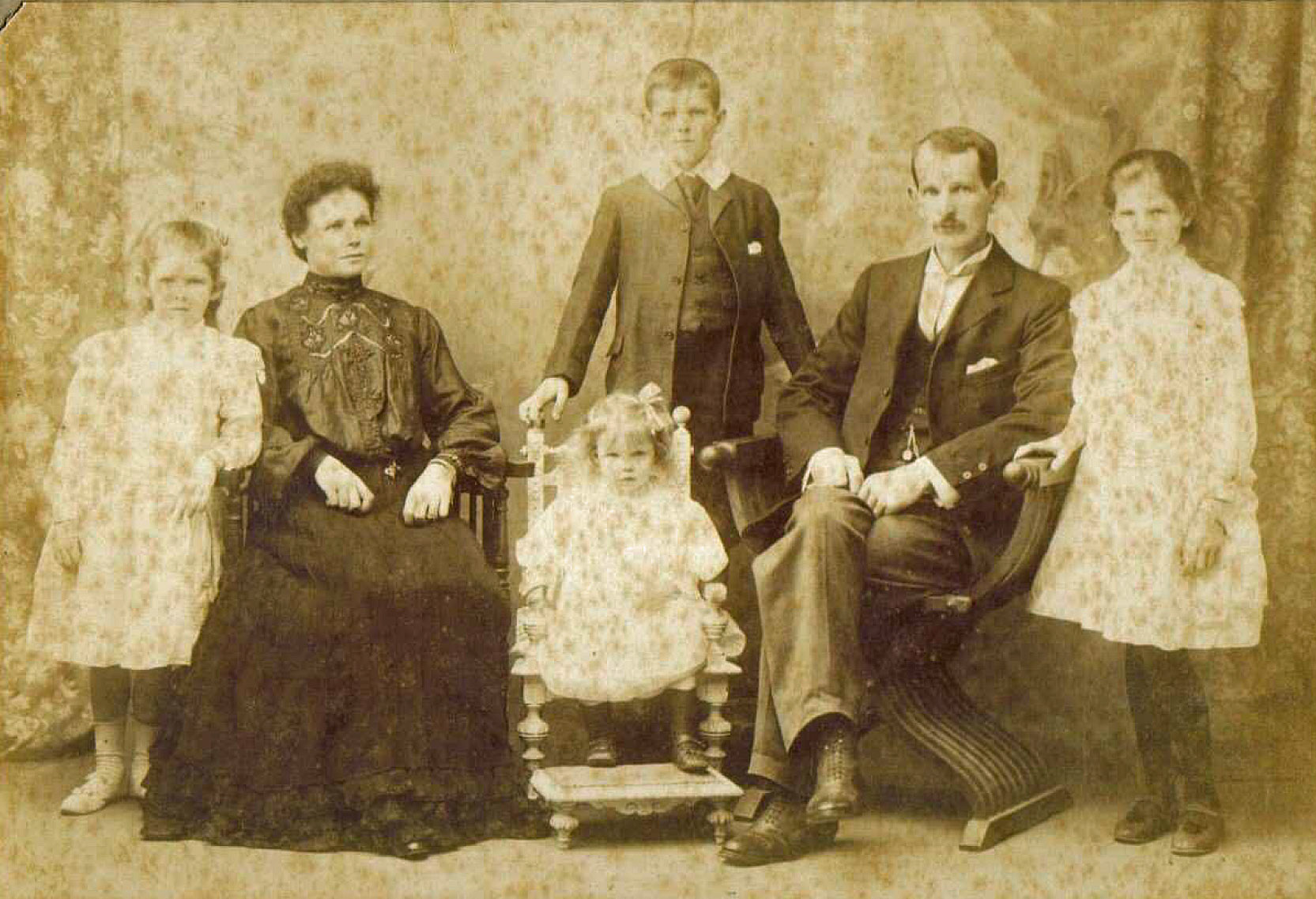
Herbert Birchley
Herbert Birchley was born in Herefordshire in 1867. He trained as an apprentice grocer, and worked for several well known grocers in Hereford, including Gurney’s in High Town.
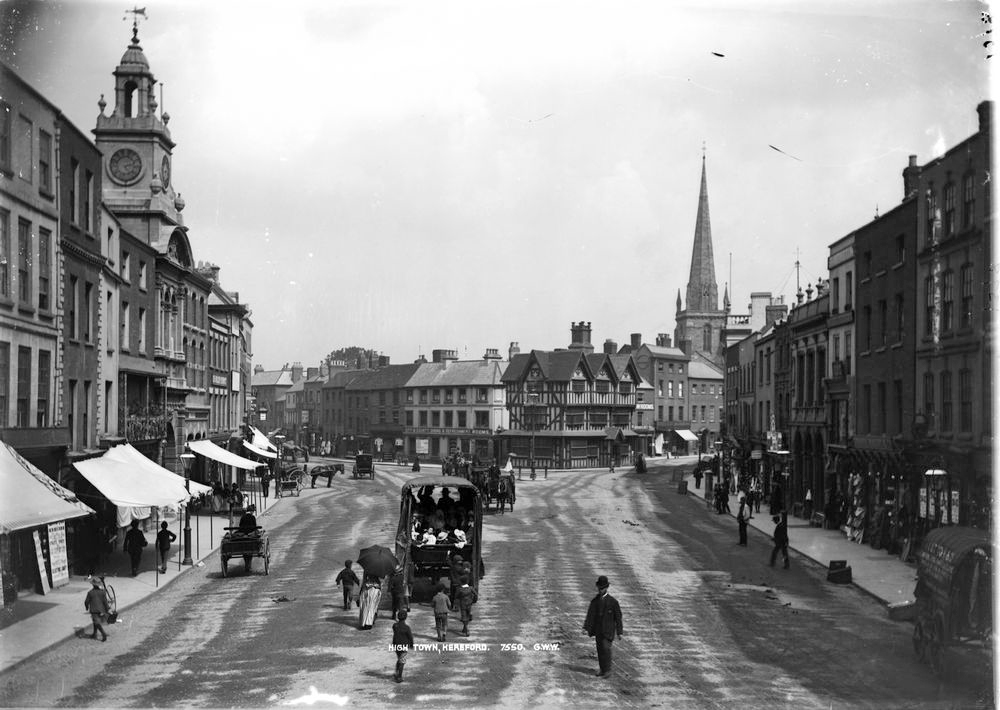
Birchley migrated to Brisbane in 1887. In 1891, he married Agnes Geddes and established a grocery store on Montague Road. In 1897, he opened a second store in Wynnum.
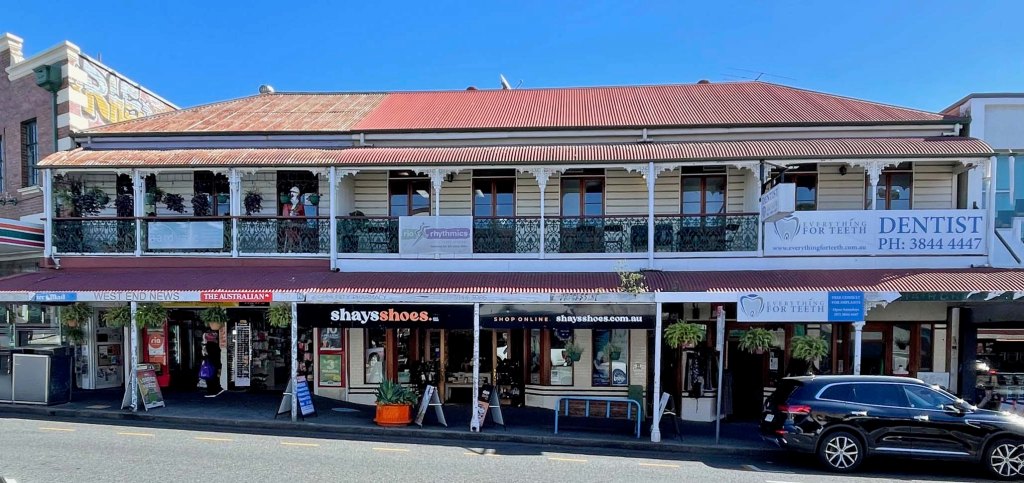
Birchley relocated the Montague Road store to 195 Boundary Street in 1903. This was the end shop, occupied by a dentist in the image below, in a two story row of four. It had been built in 1886 by Richard Rogers who had a bakery nearby from the mid 1870s.
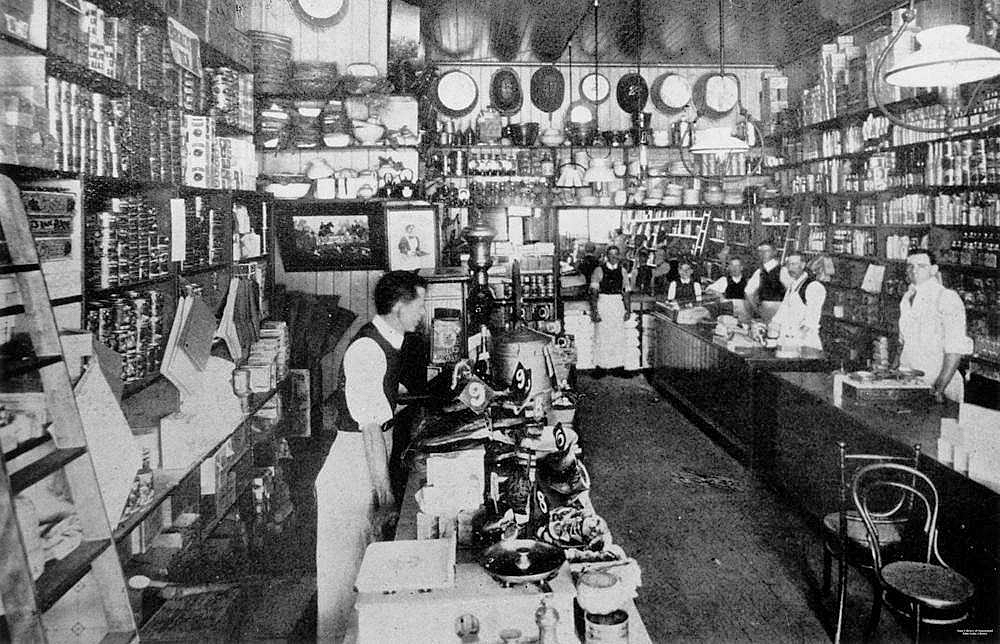
The 1909 Jubilee History of Queensland included highly flattering descriptions of various businesses, including Birchley’s.
“Nowadays, tea is regarded more in the light of a necessity than a luxury, so that when a firm becomes noted for the fragrance and excellence of their tea, it must be something quite out of the common. Yet Mr. Birchley has achieved such enviable notoriety as the result of careful and skillful blending.“
In 1922, Birchley purchased the corner allotment, and rented out the shops.
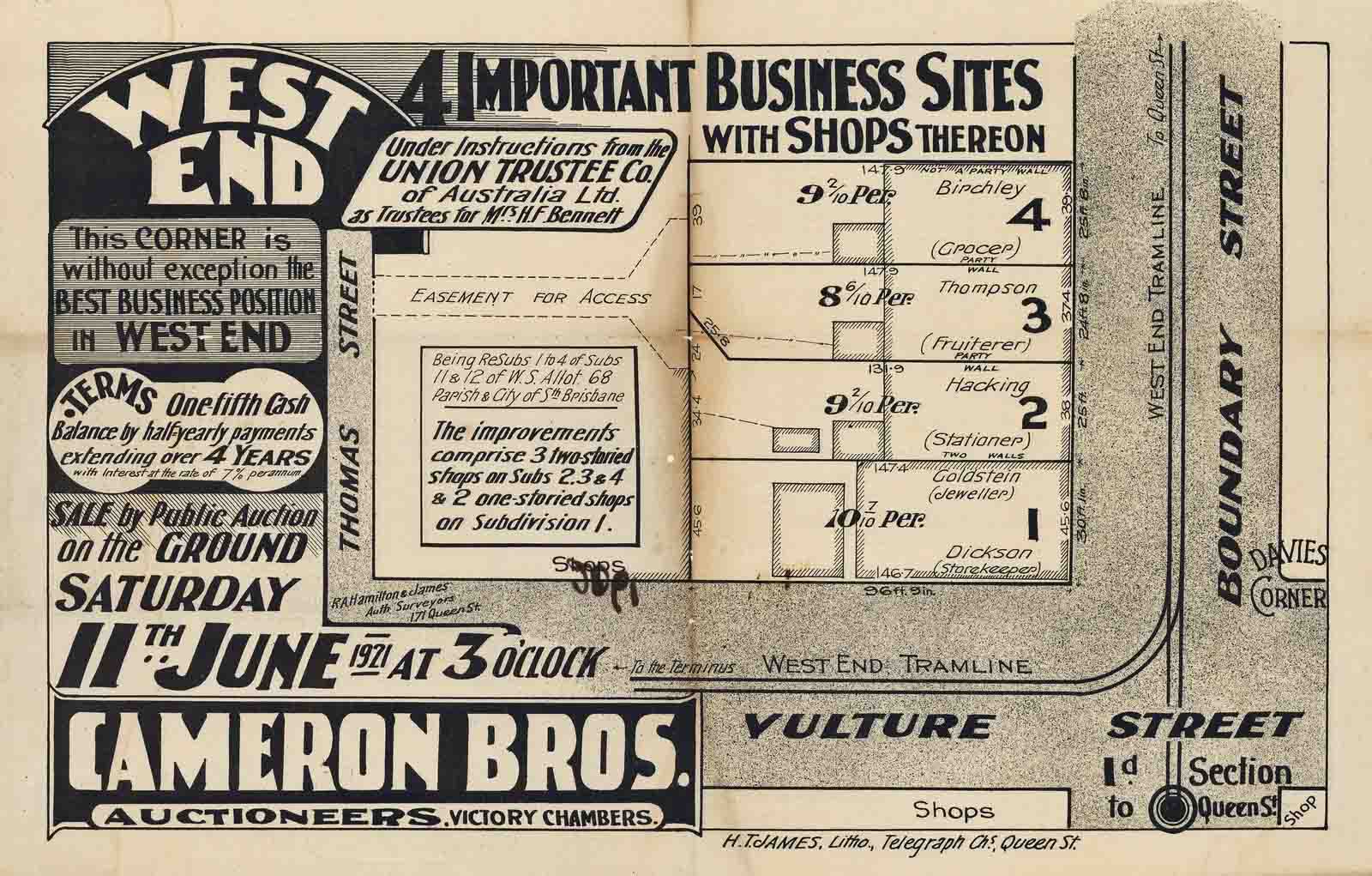
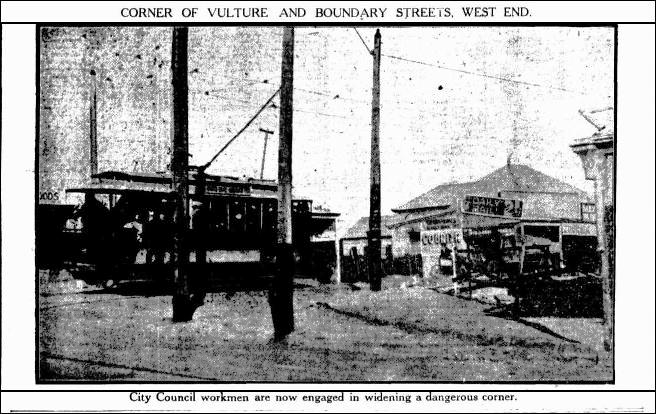
The corner was tight and considered dangerous. In 1925, the City Council decided to address the issue by widening the intersection, and resumed Birchley’s land along Vulture street.
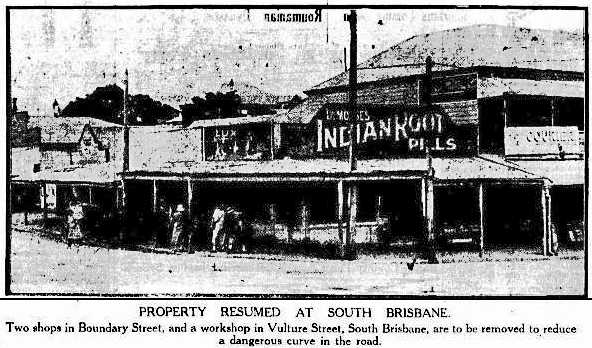
Birchley demanded compensation. In the resolution of the issue, Council returned most of the land and proceded with a smaller change to the corner2.
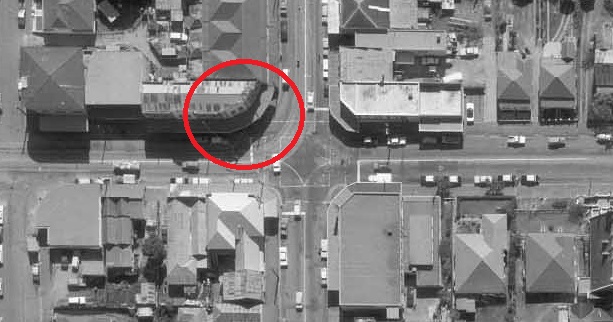
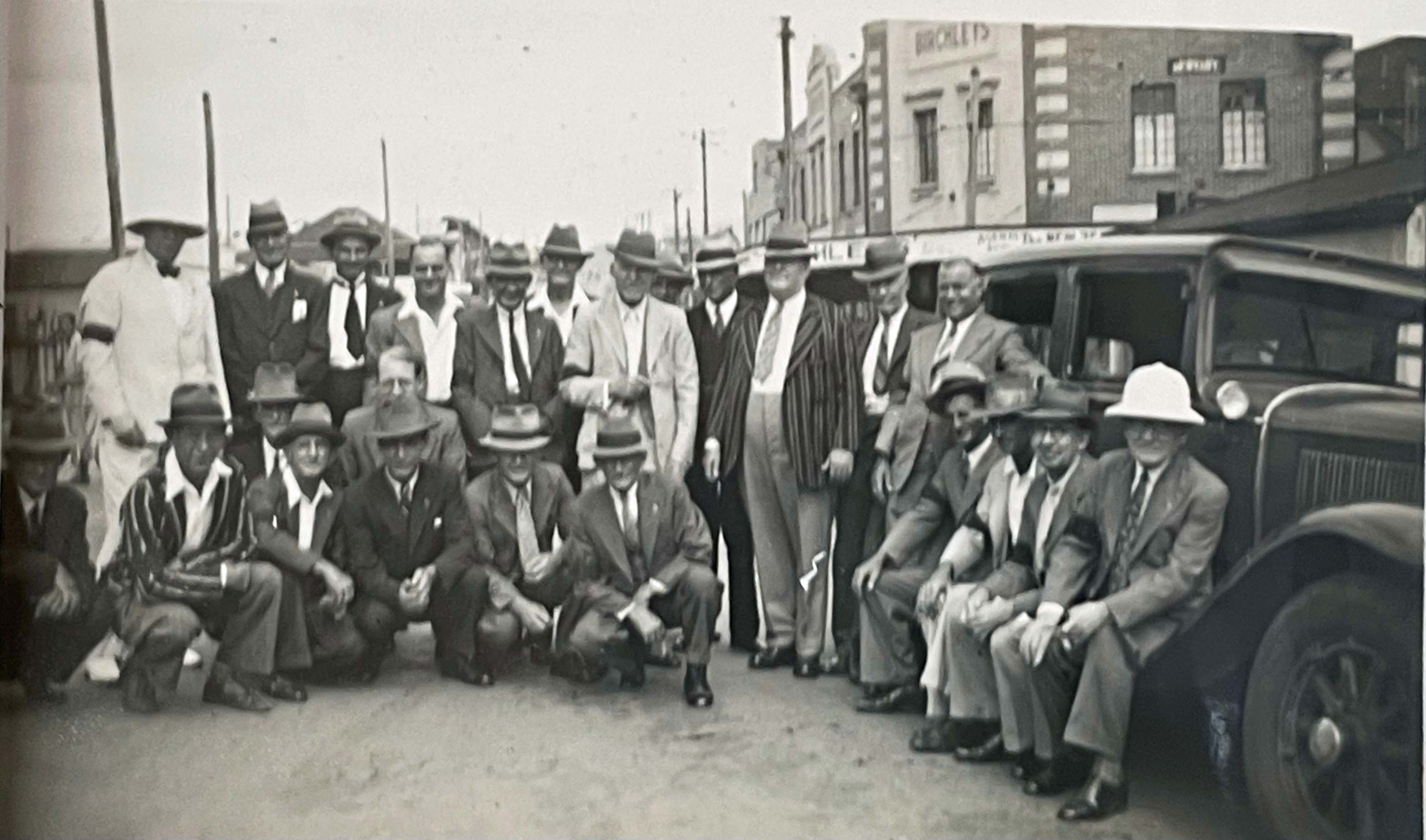
Birchley demolished the old structure, and built the brick building still standing today. In 1929 he sold the property at 195 Boundary and relocated his grocery store to the new spacious accommodation.
Herbert Birchley died in 1936, but his grocery store continued to trade on the corner until 1949. However, the winds of change were blowing in the grocery world.
William Mott dentist
William Mott from Laura Street, Highgate Hill, volunteered for military service as a 22 year old in 1915. As he had completed 4 years of his dentistry apprenticeship, Mott joined the newly formed Australian Army Dental Corps, and served for 3 years as a staff sergeant dental mechanic in various field hospitals,

In 1918, he asked to be transferred to active service, accepting a demotion from staff sergeant to private. He was posted to the 49th Battalion. Not long after, Mott dislocated his knee during physical training. By the time he had recovered, the war was over.
Mott opened his own practice on the south-east corner of the intersection in 1926, and he moved across the street to the new Birchley building in 1930 and remained there until 1946.

He later seems to have practiced until around 1960 from his home at 111 Hardgrave Road.
A family memory
My Uncle Bob Binzer told me of how in the 1930s his mother and aunt worked as seamstresses upstairs in the Birchley building. He used to go there after school and he remembered looking down into the backyard of a butcher shop and watching the butcher slaughter pigs. This was possibly Ure and Sons across the street.
Brisbane Cash and Carry
Grocery stores traditionally kept all their goods behind the counter. Employees would measure out the requested amount of each product and package it. Regular shoppers had a tab that they paid at the end of each week. Usually grocers had a home delivery service at a time when most people travelled by public transport.
The world’s first self-serve grocery store breaking this mold is thought to be Clarence Saunders’ “Piggly Wiggly” store in Memphis, Tennessee, that opened in 1916. In 1922, Claude Fraser opened Australia’s first self-service store in Anne Street, Fortitude Valley, naming it “Brisbane Cash and Carry”, later commonly known as BCC. As the name implied, there were no weekly tabs and no home deliveries.
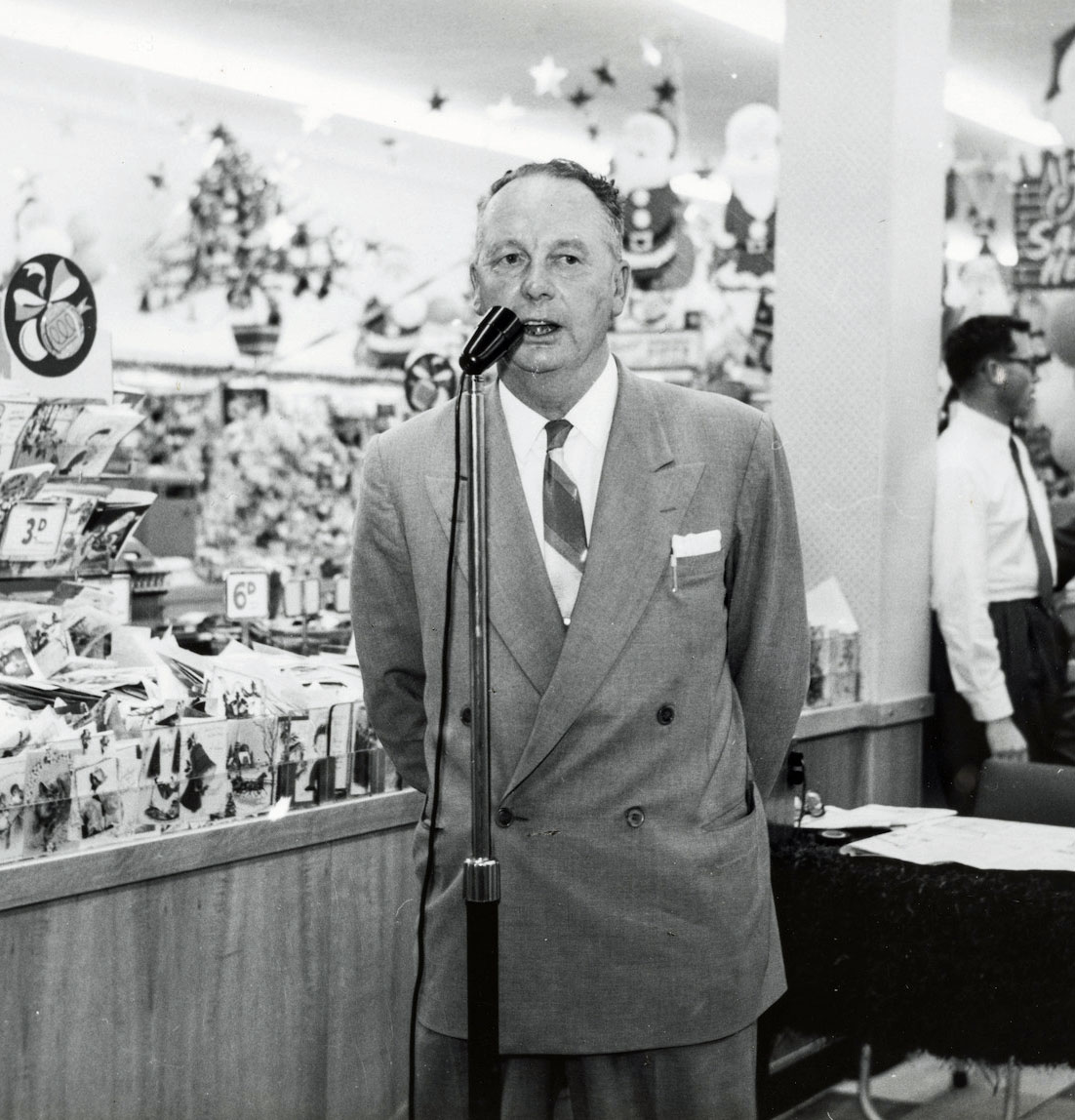
His business model was based on lower overheads, lower prices and large turnover. By 1928, the Grocers’ Association was complaining about the discounts Fraser was receiving from suppliers. The BCC chain steadily grew and in 1950, after renovations, Birchley’s traditional grocery store became the 15th BCC supermarket.
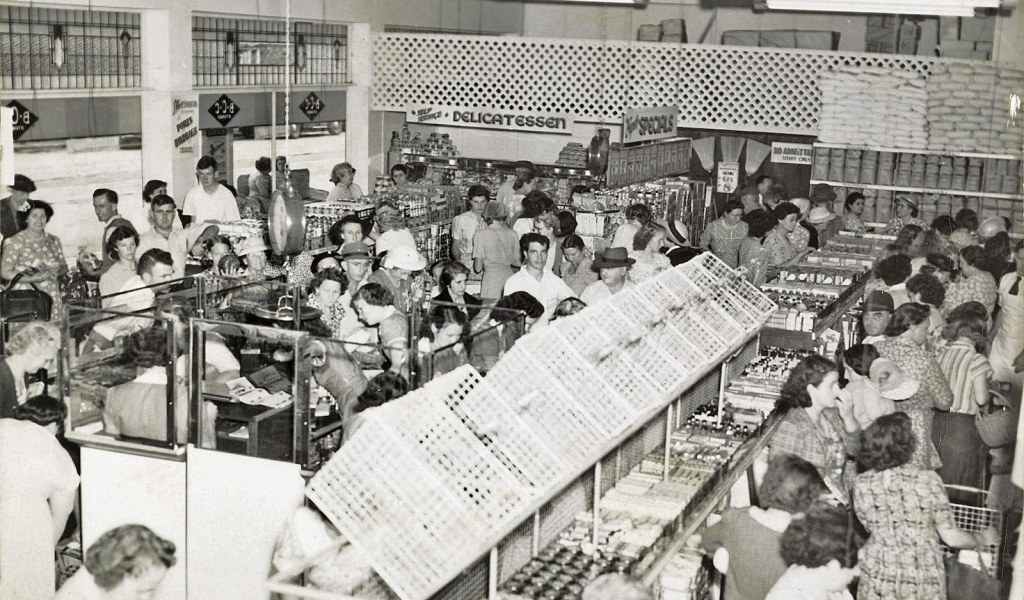
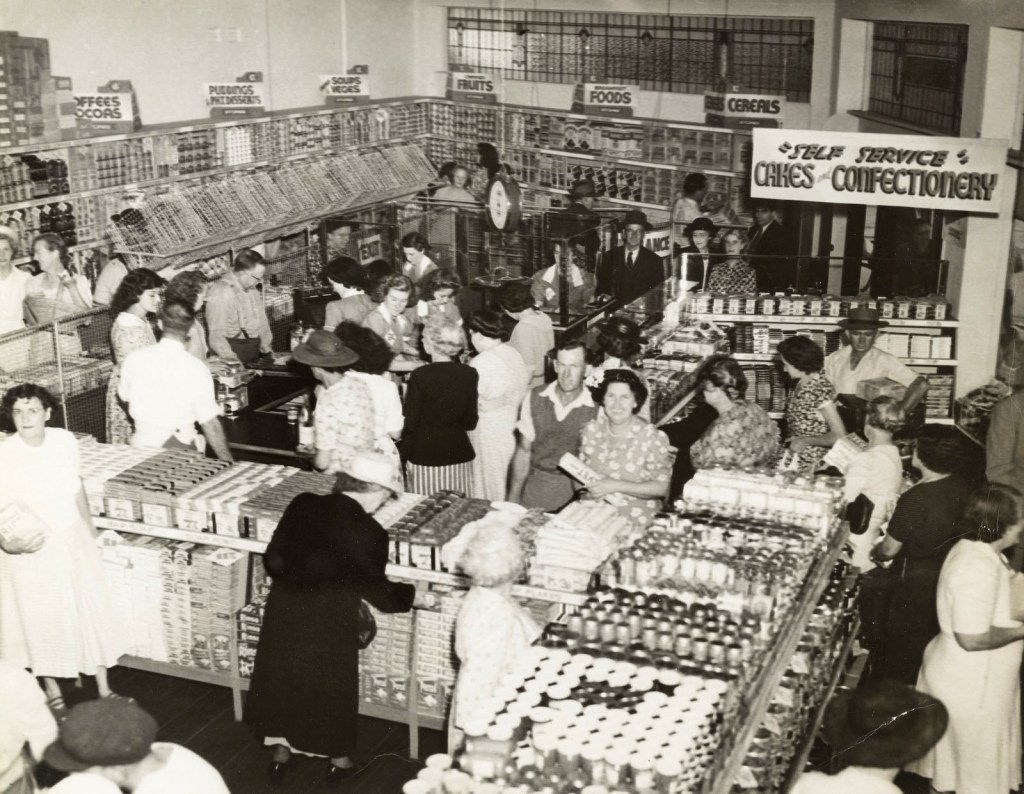
The crowd at the opening day of the West End BCC store in October 1950. (State Library of Queensland, Fraser Collection)
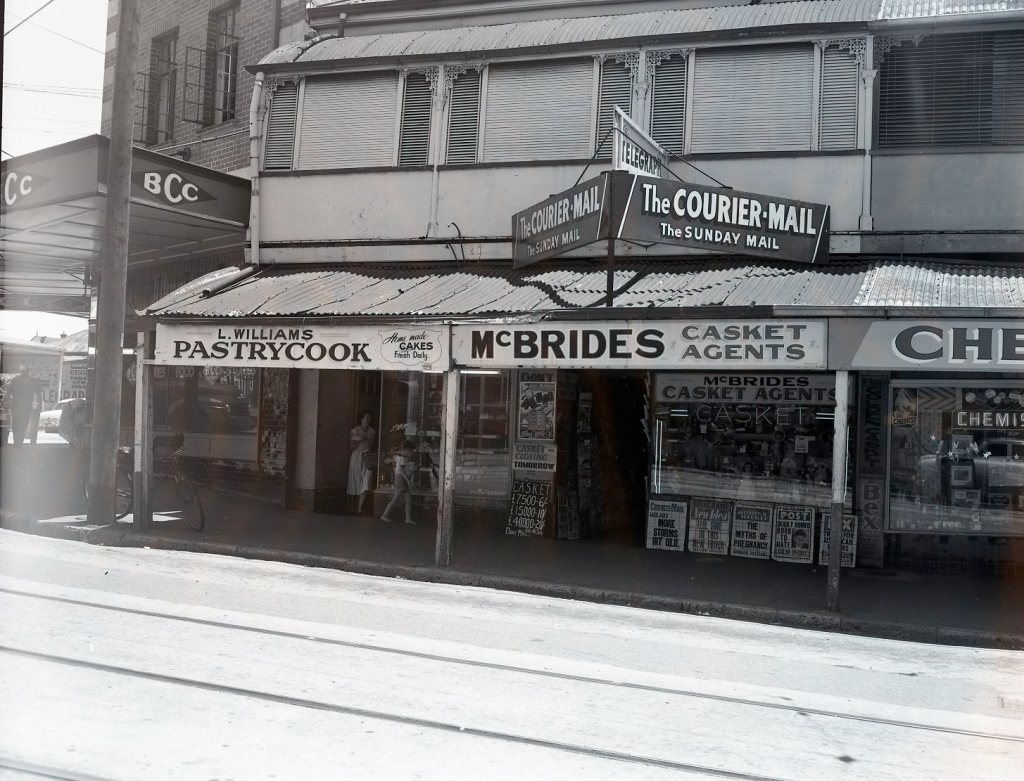
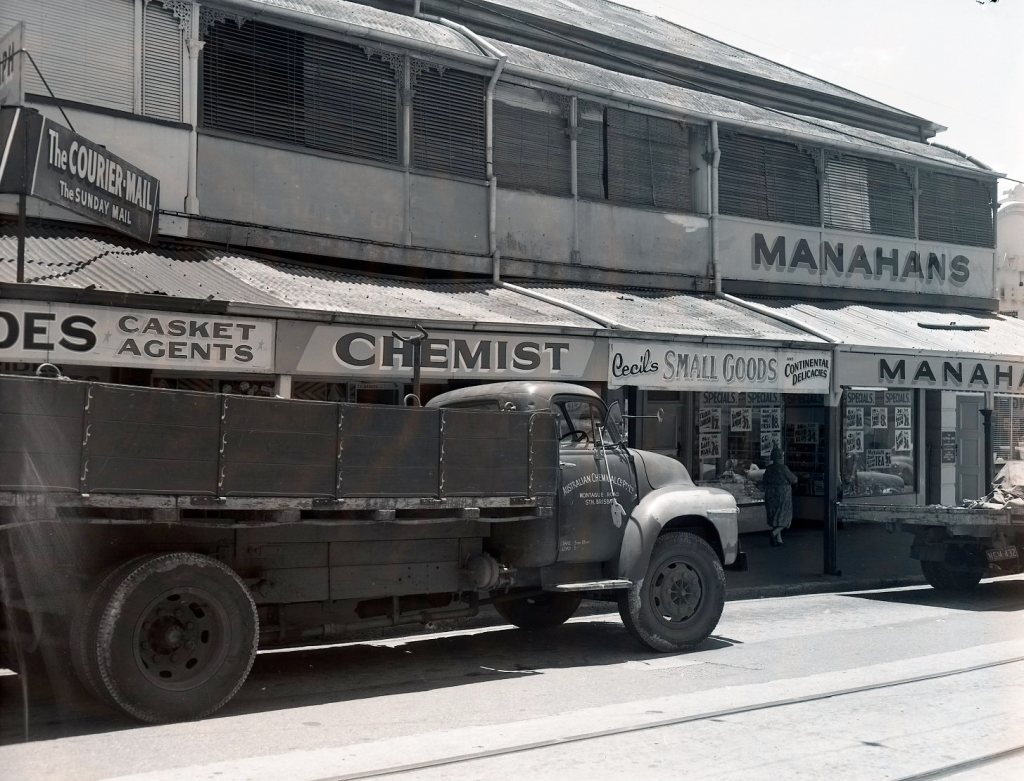
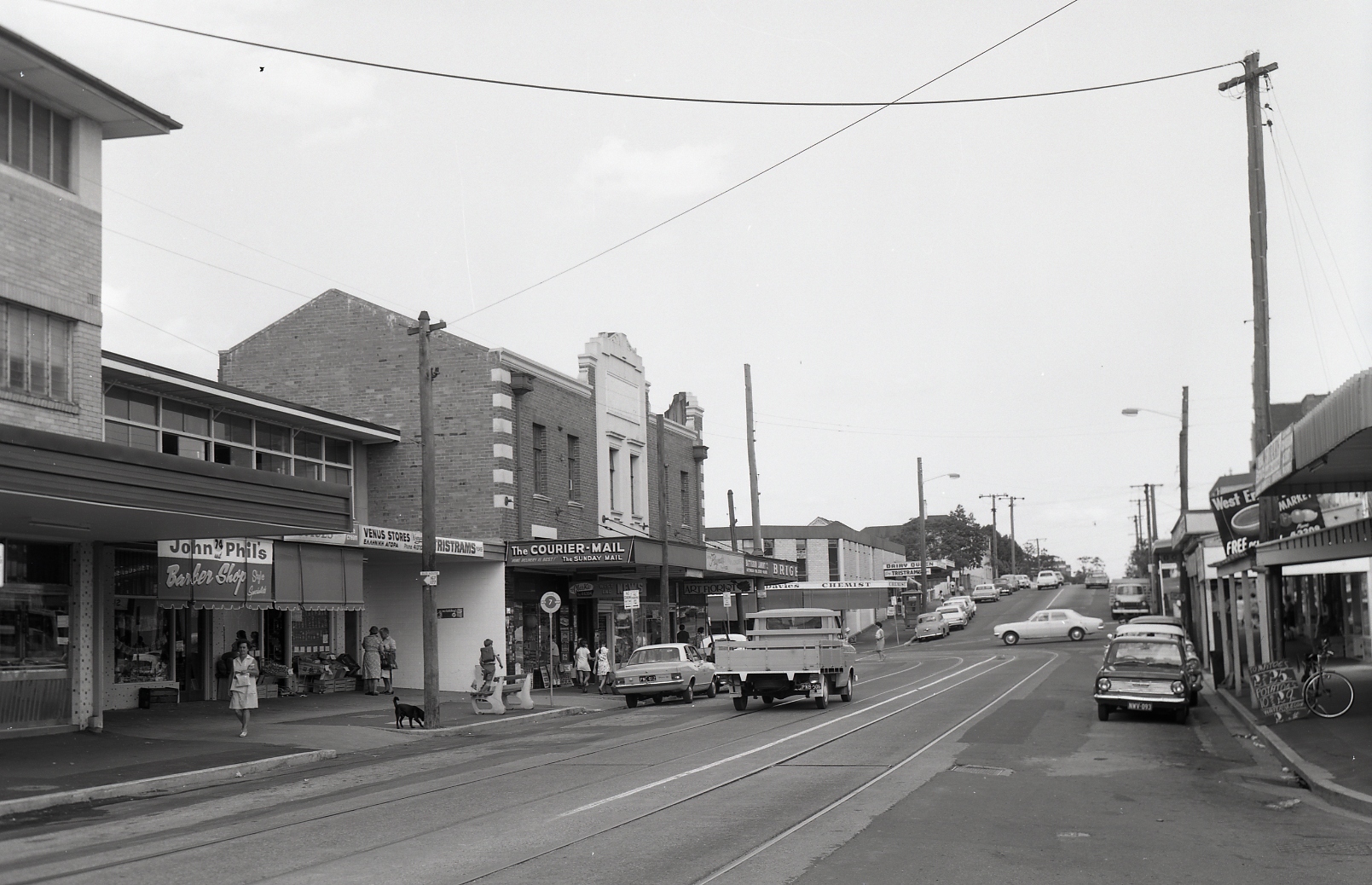
In 1962, the West End BCC moved diagonally across the street to what was probably a newly constructed building. At this time, a second BCC at 63 Hardgrave Road closed. You can find more on this elsewhere in this post.
Hardware
The corner shop was then occupied by a Brightways hardware store. Since the 1940s, the company had been steadily expanding from its original store in Queen Street.
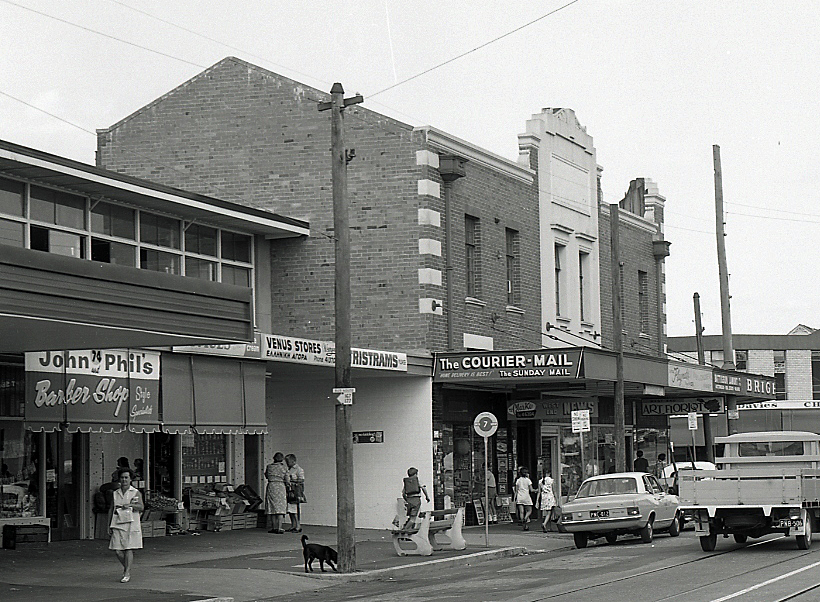
By 1991, Brightways had ceased trading and the hardware store had become part of the True Value chain.
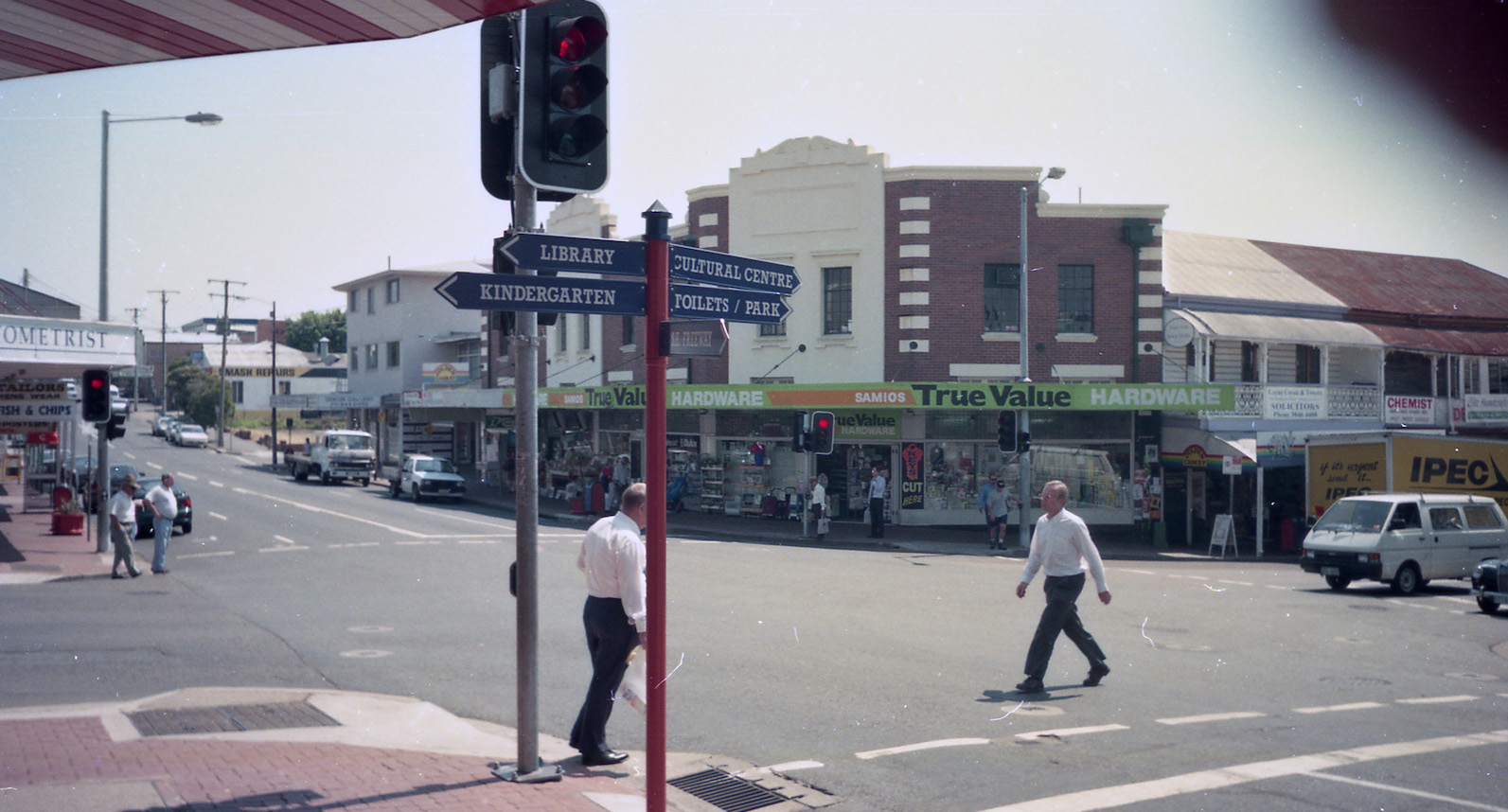
In 2024, the corner shop was occupied by a 7-Eleven convenience store. A long time occupant of the building is Govinda’s vegetarian restaurant which opened here in 2001.
154 Boundary Street – “Davies Corner”, the north-east corner
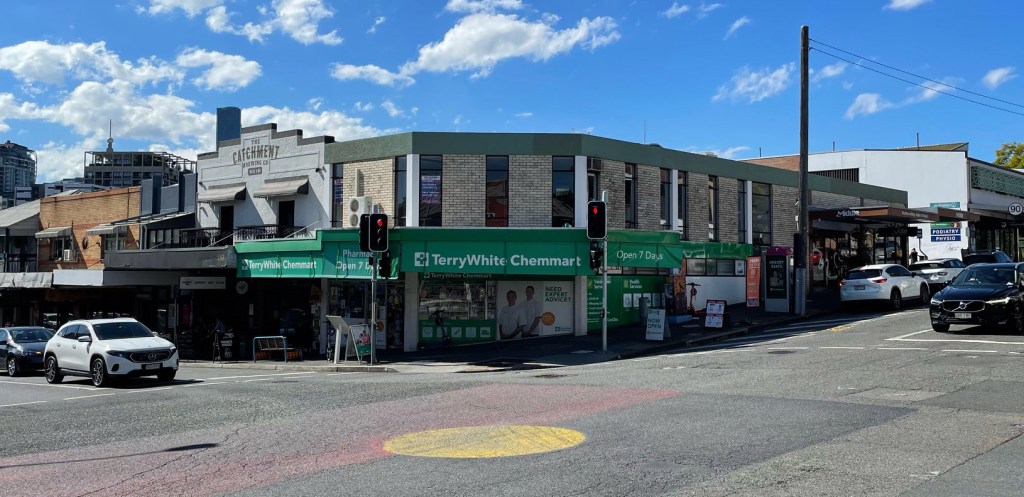
The first mention of this location is in 1887, when the Post Office Directory shows it occupied by Thomason Brothers, pharmaceutical chemists and mechanical dentists. Two years later, the long period of occupation by the Davies family began.
John Davies
John Davies was born in Herefordshire in 1839. In 1884 he married Sarah Odell, and they emmigrated to Brisbane a few years later. With experience in pharmacy, John found work with well known Brisbane chemist William Costin, managing his West End Pharmacy located on the south-west corner of the intersection.

In 1887, Davies was prosecuted for a breach of the Pharmacy Act, as he had not yet formalized his qualifications in Queensland, and was working unsupervised. Costin wrote a letter to the editor in Davies’ defence, although one would think that Costin shared some of the blame by placing Davies in this illegal situation.
Davies moved across the intersection to run Thomason’s pharmacy, passed the required examination, and was registered as a pharmacist in 1889. In that year, he acquired the business. Costin was going through the third of his insolvencies and his West End Pharmacy closed.
Davies’ new business got off to a bad start, as in July of 1889 a fire started in an adjacent building destroying Brown’s grocery and Blasdales’s boot shop, and damaging Davies’ pharmacy. Luckily there were no injuries.
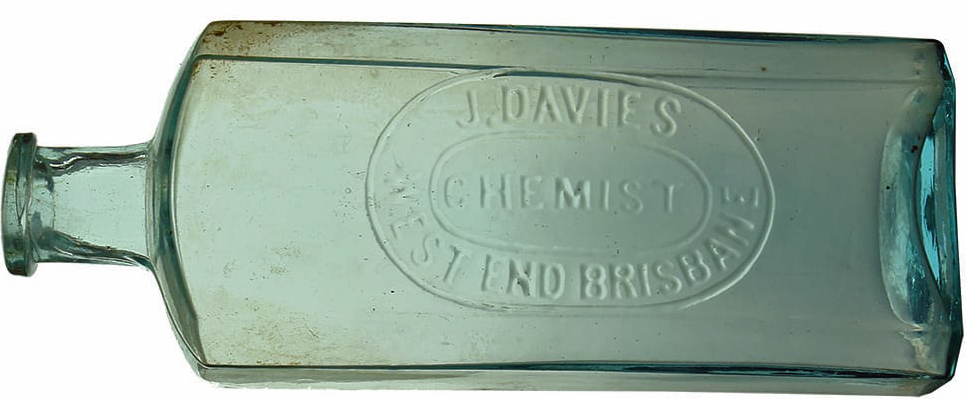
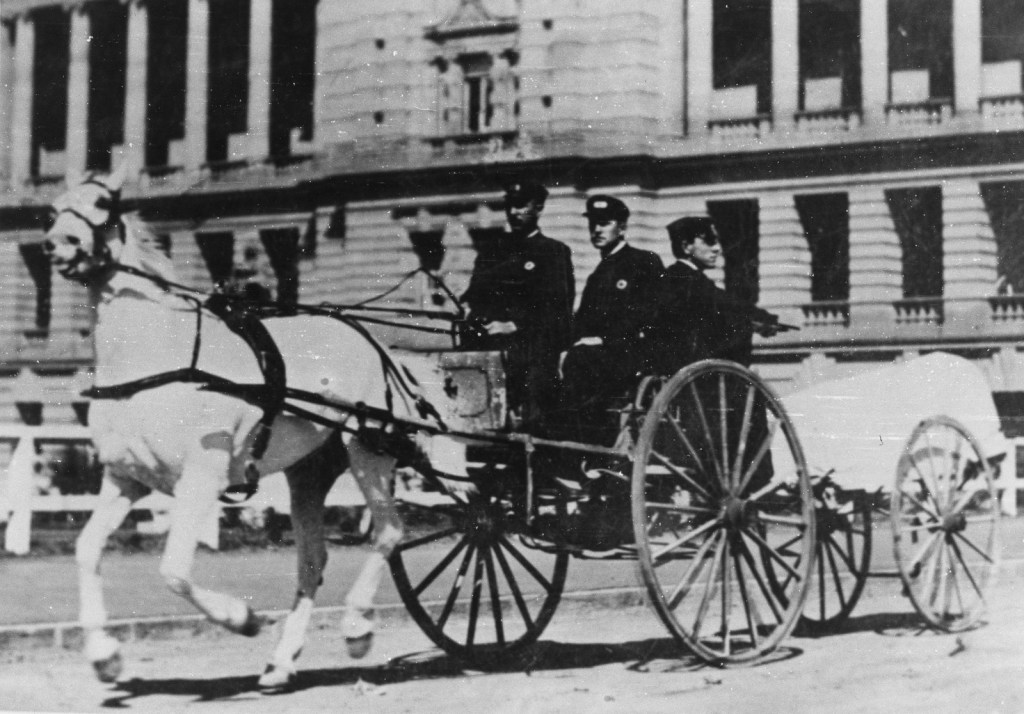
The pharmacy became a de-facto first aid centre, especially after Davies installed a telephone in 1898. People suffering from the results of such diverse incidents as being kicked by a horse, bitten by a shark, or slipping on an orange peel, were rushed to the pharmacy for first aid. Pharmacy staff called the ambulance when the injuries were serious. It got to the point that the Posts and Telegraphs Department investigated the number of free emergency calls being claimed.
The pharmacy was open from 8 am to 10 pm, but Davies found time for other activities. He served as an alderman in the South Brisbane City Council, and as mayor in 1905. His passion for sport and recreation led him to champion the Council’s purchase of land for both Davies and Highgate Hill Parks. (See my posts The Davies Park Story and Highgate Hill Park for more.)

(South Brisbane District Cricket Club History)
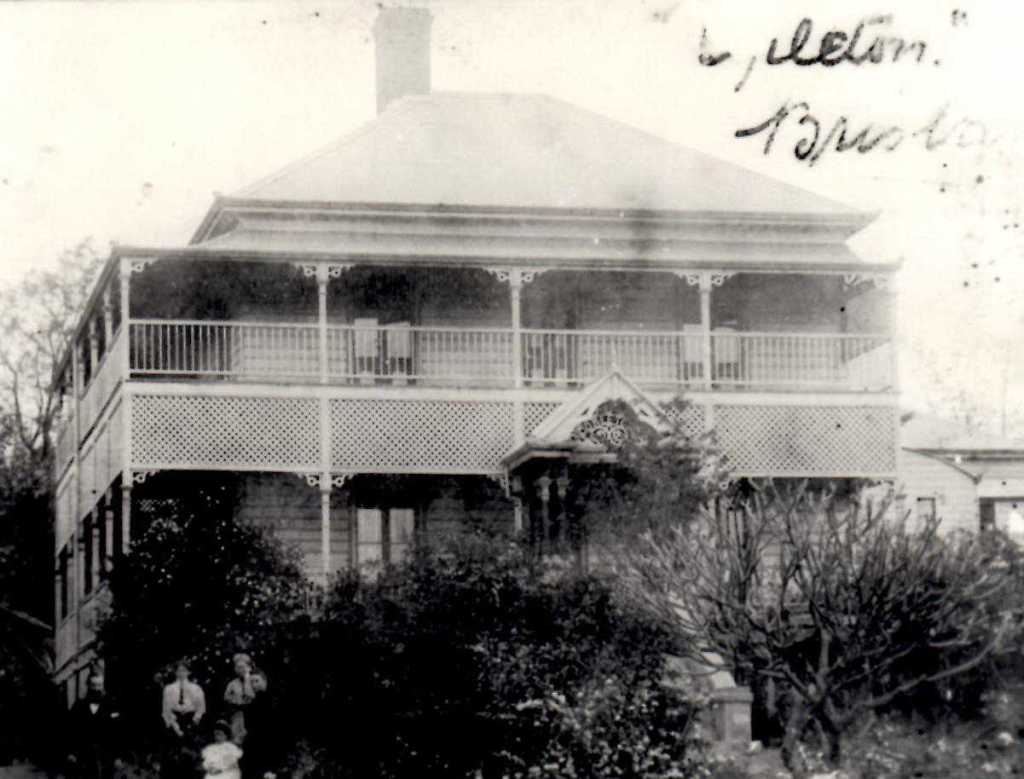
To gain certification as a pharmaceutical chemist, those without British or Irish qualifications completed a three year apprenticeship. They also attended classes at the Brisbane Technical College to prepare for the required examination. Students studied chemistry, botany, pharmacy and materia medica.1
John Davies took on a number of apprentices over the years. One of these, in 1894, was Charlotte Augusta Lavina Sophia Skyring, known to her friends as Lotty. She was an outstanding student, achieving an unheard of 100% in her botany examination.
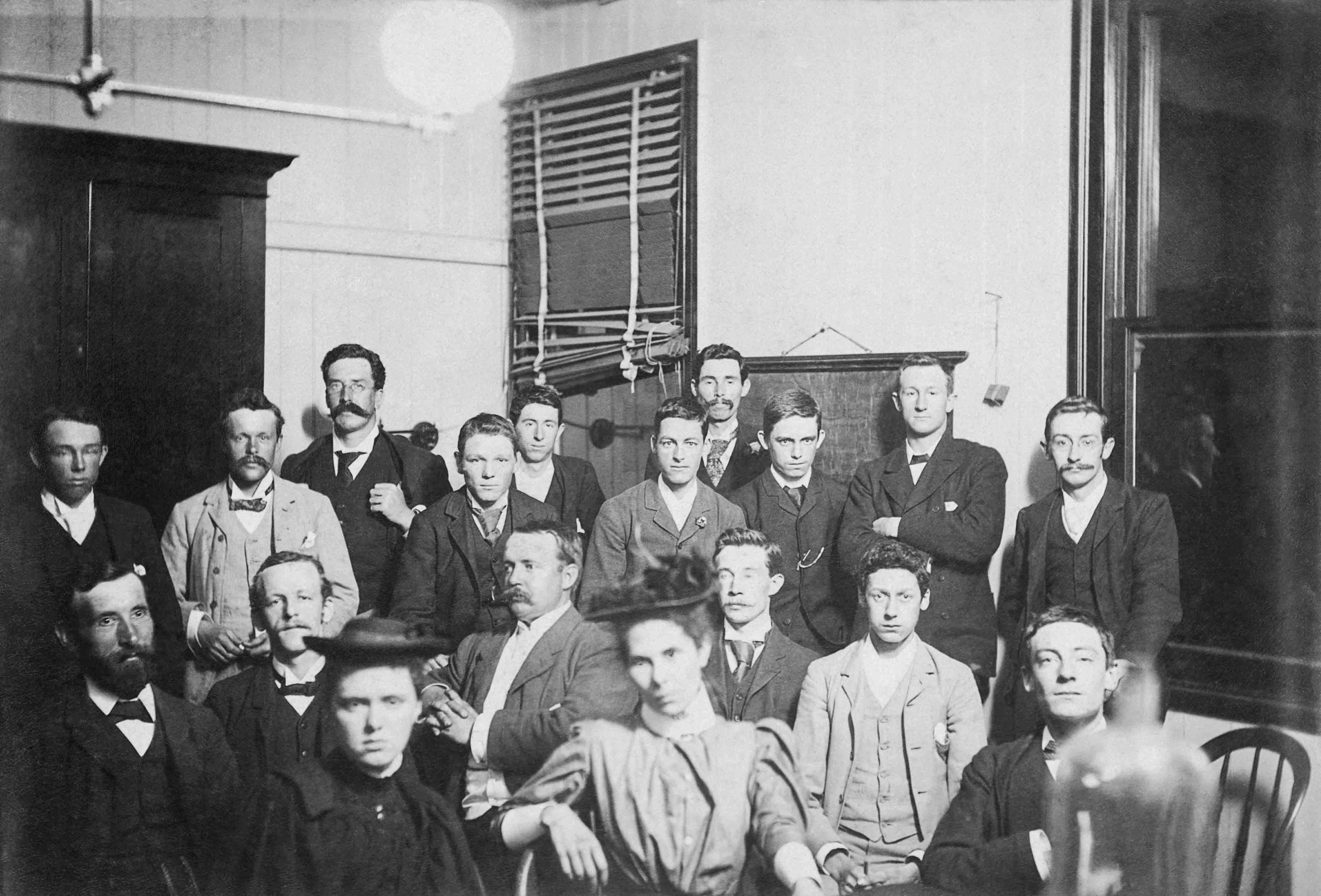
These were early days for female pharmacists and it wasn’t until 1900 that the first women were registered as pharmaceutical chemists in Queensland. Lotty filled in for some months as dispenser at the Ipswich hospital before going to Sydney to work as a private nurse, and then marrying.
John Davies passed away in 1911. There was a well attended funeral with a procession from West End to the Toowong cemetery, with mourning coaches followed by a landau filled with wreathes.
Another of John Davies’ apprentices was his nephew James Percival Davies, who had moved up from his birth place in Victoria. he was known as Percy, or more commonly JP. He took over the business after John’s death, and the pharmacy was then known as “J. P. Davies”.
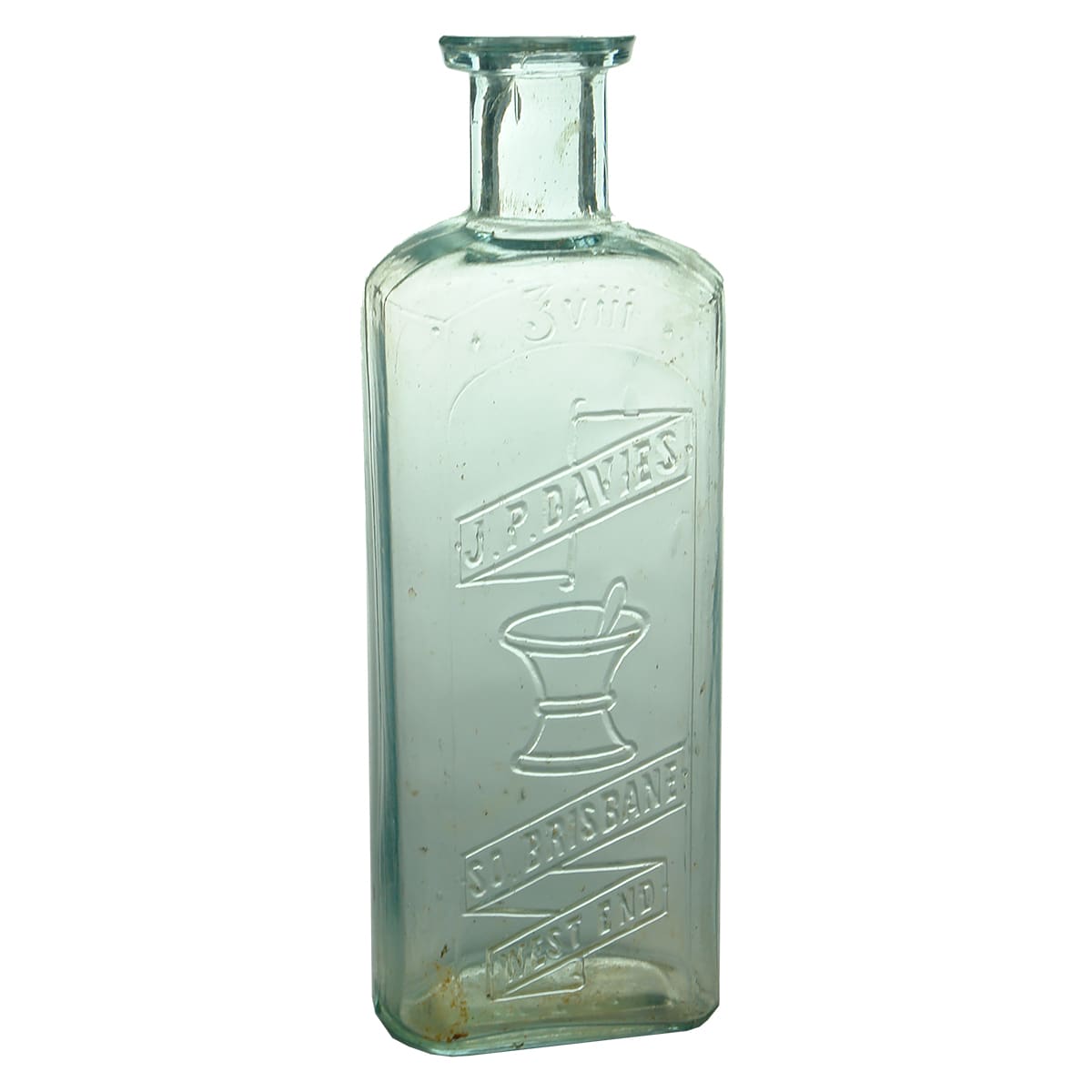
J. P. Davies
Percy Davies married Isabel Bleakley in 1911, and they lived in Kensington, at 25 Dornoch Terrace, where they brought up their three daughters. A son died a day after his birth.
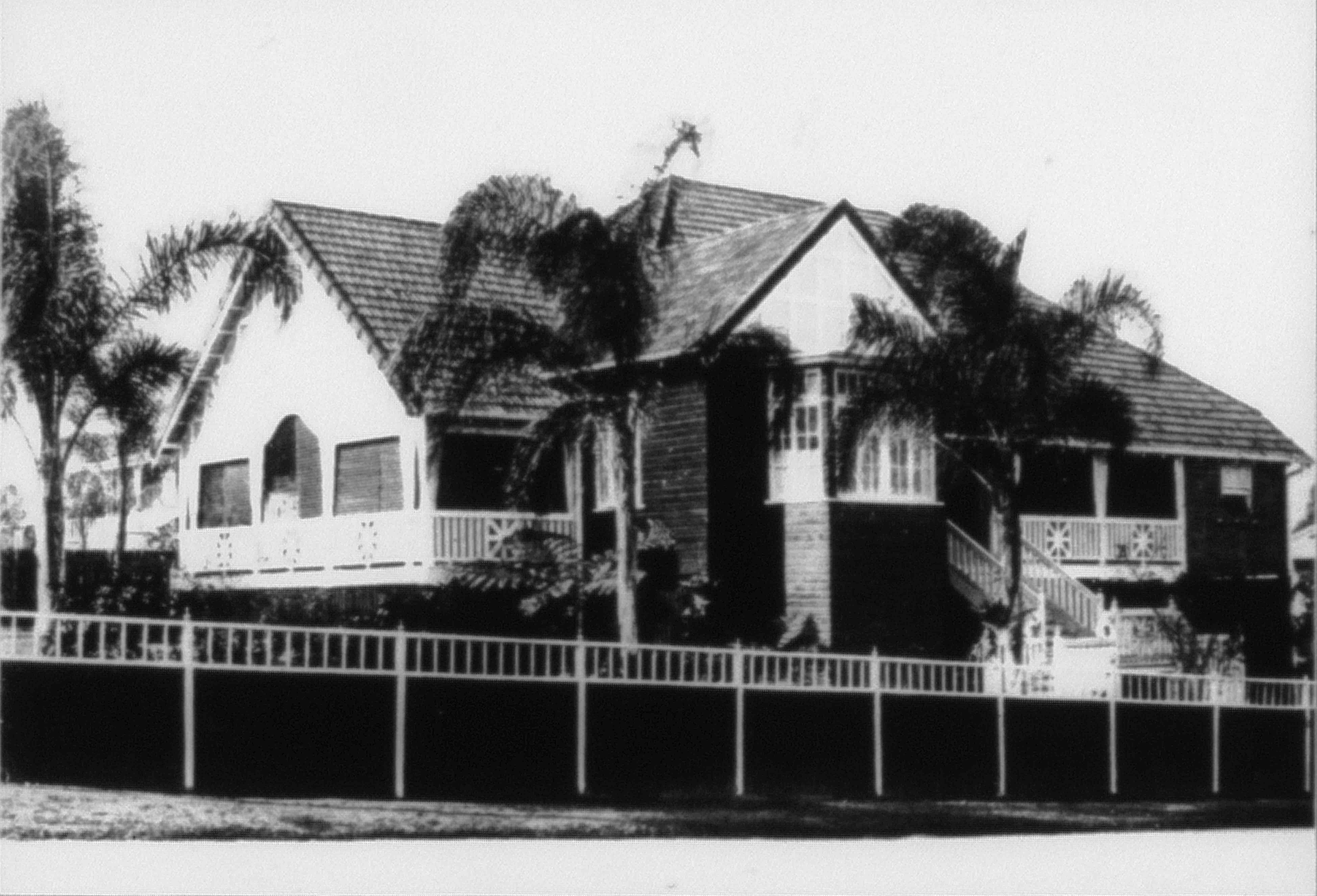
In 1936, a strip of land comprising 5 shops along Boundary Street adjacent to the corner came up for sale. It included Davies pharmacy and Shay’s boot making shop next door. This lot of 12 5/16 perches, or just over 300 square metres, was purchased by Davies for £700.
Following in his Uncle John’s footsteps, in 1939 he contested the seat of alderman representing the Kurilpa Ward, but was unsuccessful. During World War Two, JP served as chief air raid warden for the West End District. I’ve written about this in my post War Comes to West End.
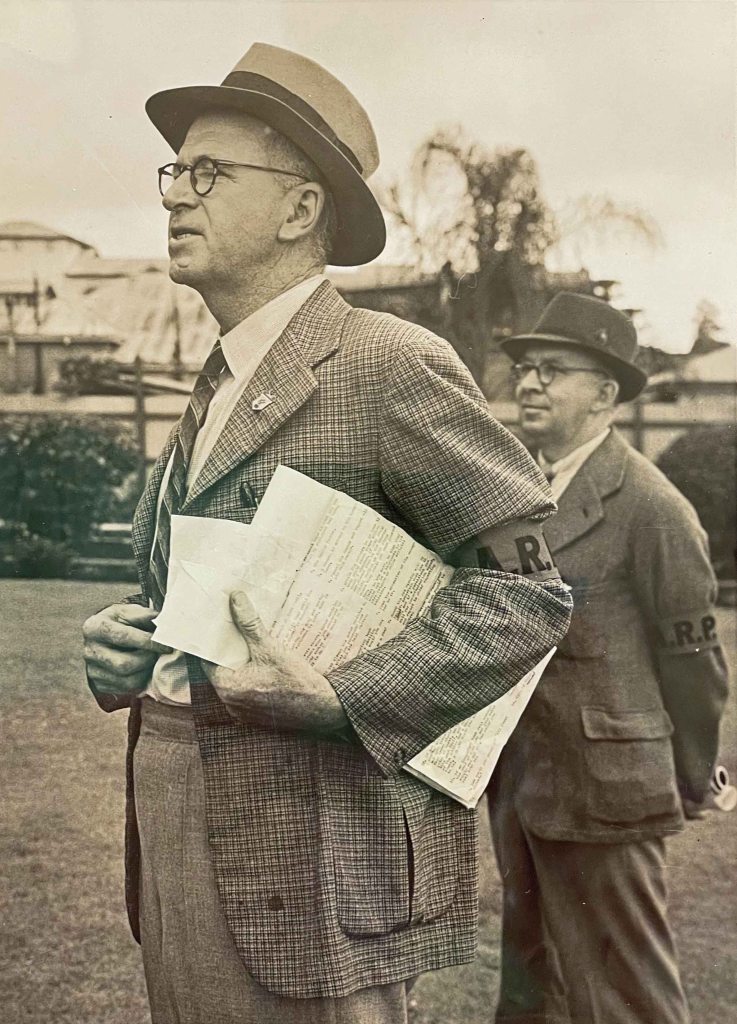
In 1931, JP’s daughter Doris started her apprenticeship with her father, and she was registered as a pharmacist in 1935.
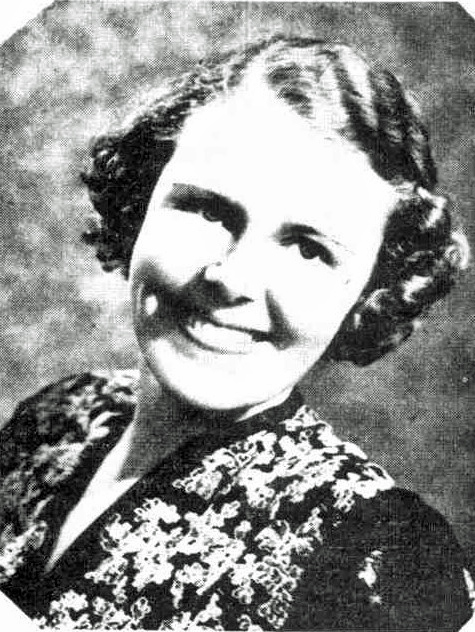
JP died in 1948. He had worked in the pharmacy for 49 years from the beginning of his apprenticeship in 1899. Davies was affectionally known as “The West End Doctor”. Doris continued the business, taking on several apprentices herself.
In the late 1950s, Doris and her sisters purchased the adjoining property and replaced the 1889 building with the larger premises that occupies the corner today. In the mid 1960s, Doris’s daughter Susan Thynne became the fourth generation of the family to study pharmacy, although by this stage the apprenticeship system had given way to a university course.
The family sold the business in 2008.
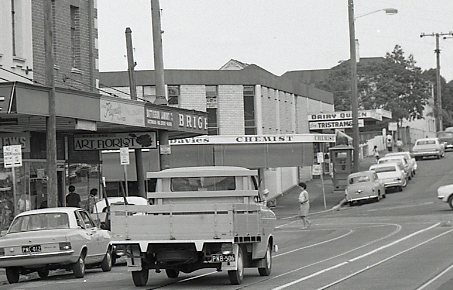
After 137 years, the site continues as a pharmacy, now under the banner of Terry White Chemists.
Shay’s Shoes
There were boot makers next to Davies’ Pharmacy since 1889, run by Sam Blasdale, and then by Alex Cameron. In 1901, Bernard Shay took over the shop. He was joined by his brother Dennis who bought the business from Bernard in the 1930s.
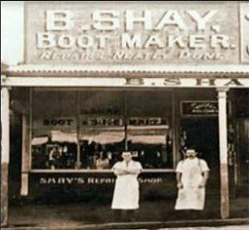
(Shays Shoes)
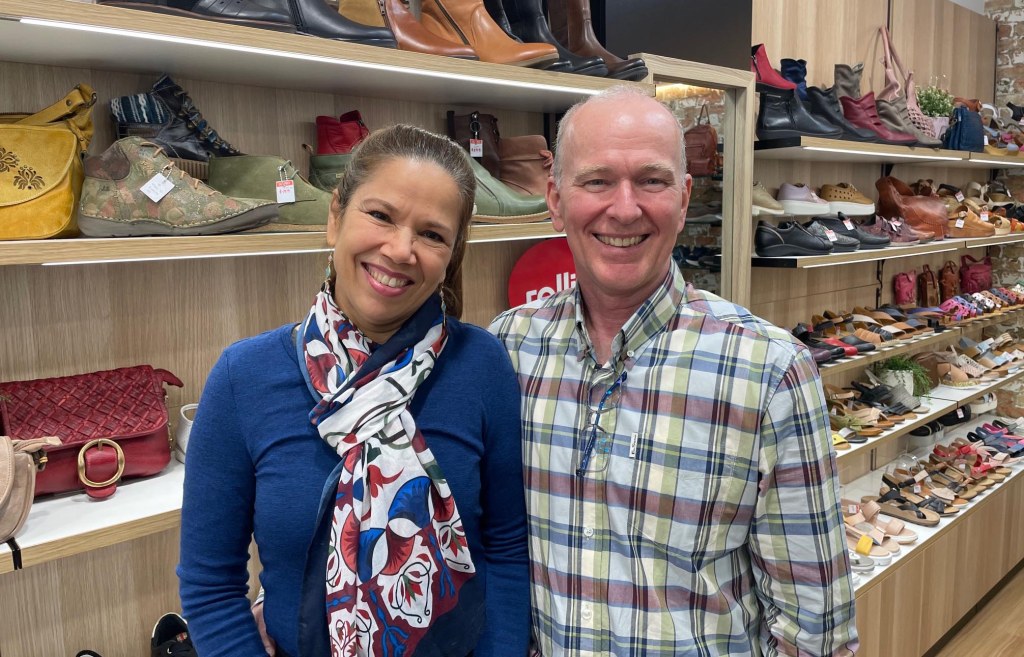
Dennis’ son Greg joined his father and took over Shay’s Shoes after Dennis passed away. The shop moved to 126 Boundary street in 1950. Recently its current owners Greg’s son Wayne and his wife Moira have relocated to number 197, across the street from the original location.
205 Boundary Street, the south-west corner
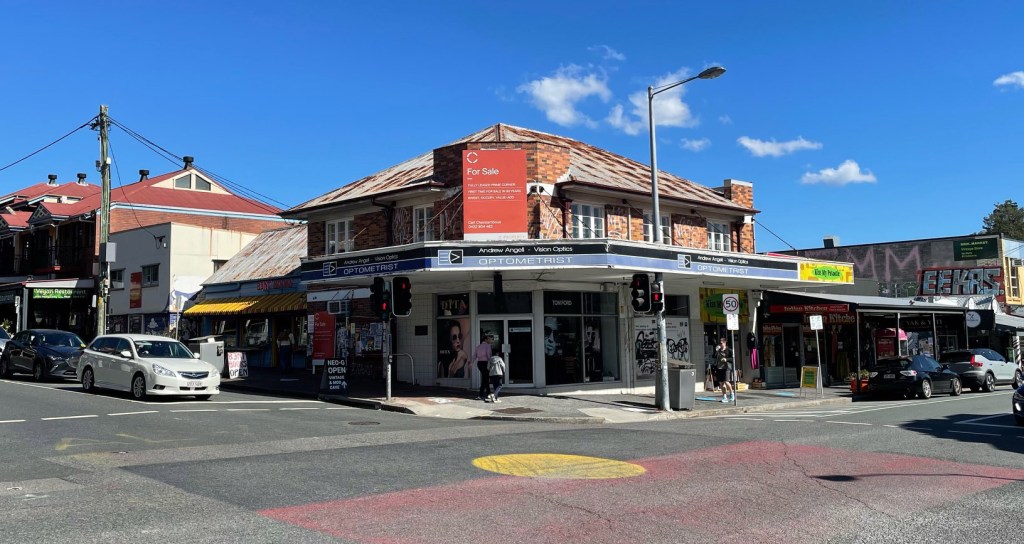
The first Post Office Directory entry for this corner is of Mary Aitken, storekeeper, in 1878. From 1885 until 1889 it was a pharmacy, first run by John Lumm and then as Costin’s West End Pharmacy, under the management of John Davies as described above.
Trittons
In 1884, William and Sarah Tritton, along with their four sons, emigrated from England. Their son Fred later recounted
“In the first few years here, my father took up some land and wished to make us all farmers, but not having had previous experience, it became irksome and my brothers and I wished to start out in business on our own account.“
In 1886 , brothers Frederick and Charles, both in their early 20s, established a second-hand furniture shop in Logan Road, Woolloongabba. Soon after, they started selling new furniture. When both brothers married in 1889, they decided to go their separate ways. In 1890, Charles opened a furniture shop on this corner, but he was only here for a few years before he moved to Sydney. His brother Fred’s business in contrast grew steadily and became a household name in Brisbane.

Meat and veg
The corner was then occupied by a butcher’s shop for almost 10 years, followed by Young Lum who ran his fruit shop here for around 15 years. The Buckley family took over the fruit shop, and in 1921 they complained about white ants. The building owner, Edward Cardell, spread an arsenic based poison around the site. Ivy Buckley moved her children out of the accommodation upstairs for 7 weeks after they felt sick.
In a subsequent court case, the judge found in favour of the building owner Cardell, as Buckley had agreed to the use of poison and it could have been cleaned up quickly.
By the mid 1930s, the corner was once again operating as a butcher shop by Archibald Ure and Sons. No occupants are shown in post office directories from 1936 until 1946, although publishing of directories was irregular during World War 2.
Peter Aroney
Panagiotis Nicolaou Koumesopoulos was born in Aroniadika, Kythera, Greece, on 1st January, 1886. In 1900, at just 14 years of age, he migrated alone to Australia and anglicised his name to Peter Aroney.
This remarkable man returned to Greece twice to volunteer in the military forces. In 1919 he returned from his second trip with his wife, Irene Mavromatis, and his younger sister, on a trip involving four ships, rioting in Alexandria and cyclonic weather off Western Australia.5
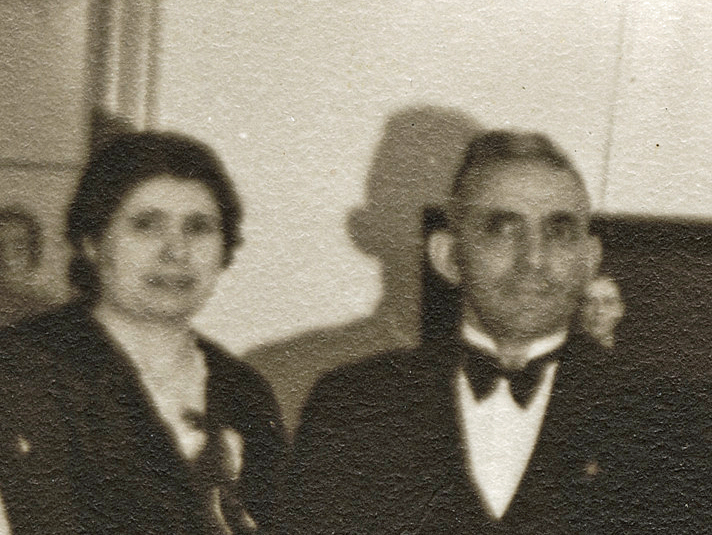
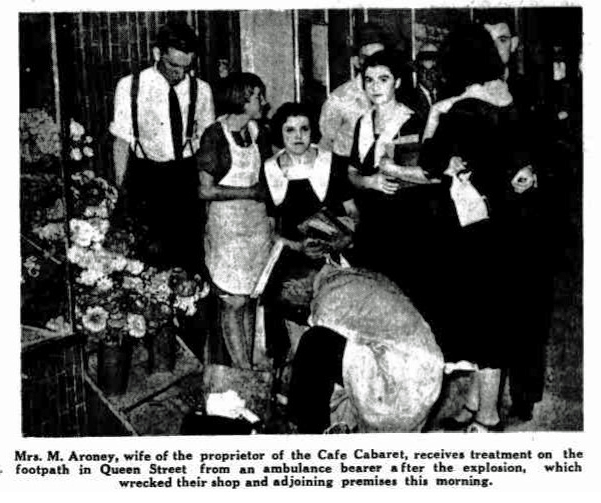
The family ran a fish shop, and later the popular Cabaret Cafe in Queen Street, adjacent to His Majesty’s Theatre. The confectionary they made on the premises was an important feature of the cafe. A gas explosion in 1937 caused injuries and damage, and later that year the lease expired.
In around 1940, Aroney purchased the property on the south west corner. The family lived upstairs, rented the shops, and established a confectionary manufacturing facility “at the back of the premises” 5. Plans for the construction of the existing brick building on the corner were approved early in 1941. The older wooden annex in Boundary Street was incorporated under the roof line of the new building, and is probably where the family made the sweets.
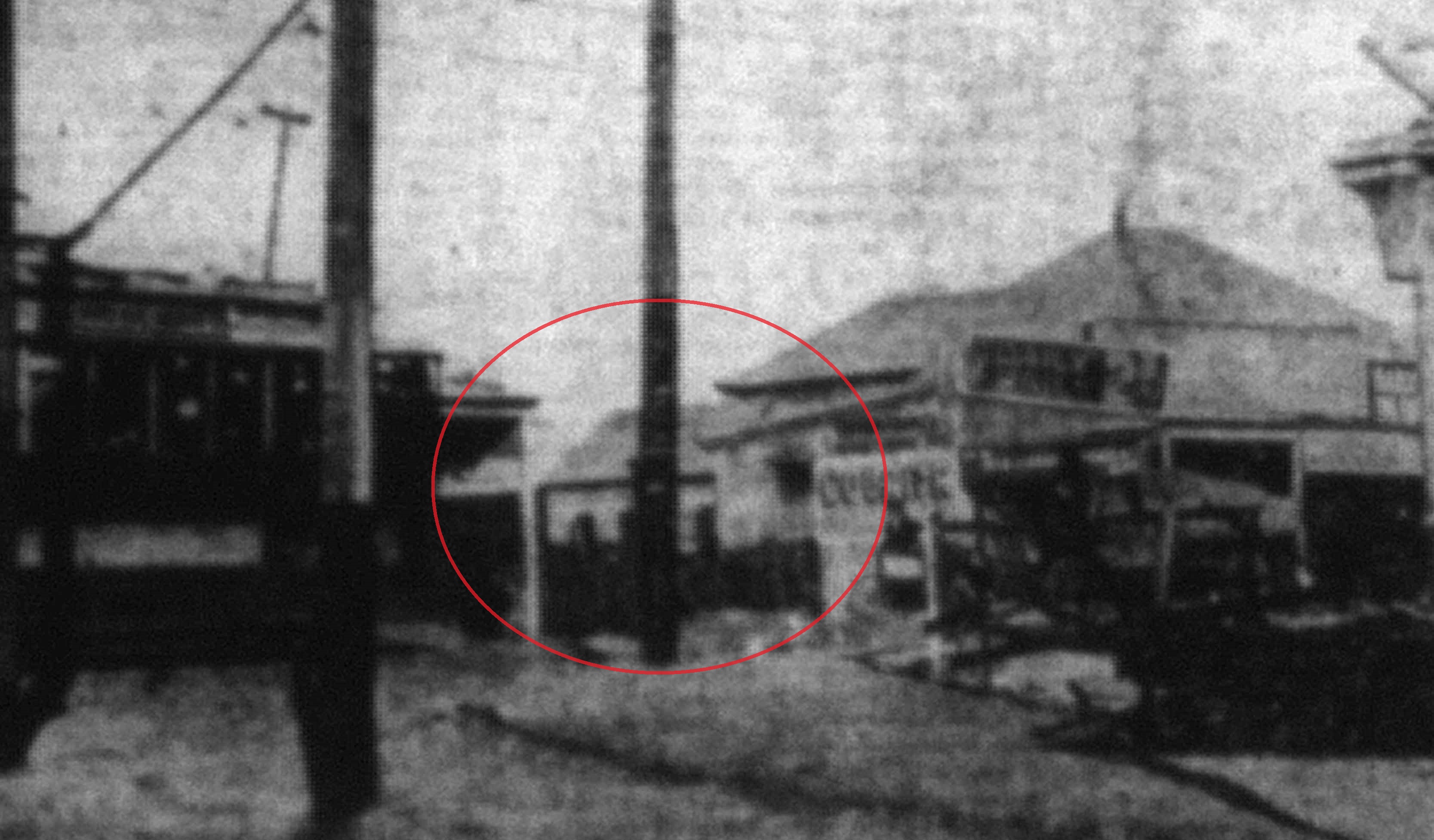
Aroney realised that the impending Pacific war would lead to material shortages, and he stockpiled 15 barrels of glucose, three tons of sugar, and half a ton of gelatine4. From late 1941, large numbers of American military personnel with sweet teeth arrived in Brisbane, and business boomed. Denis Conimos recounts in his book The Greeks in Queensland4
“Assisted by Con Cholakos, a few female employees, his wife Irene and his daughters Zaphiro and Mary, he worked from 6am to 10pm seven days a week to cope with the demand.”
Aroney sold off his equipment in 1952. The next year his son Doctor Nicholas Aroney started his practice in the building and continued there until 1994. Peter Aroney was heavily involved in Greek community affairs for much of his life and was awarded an OBE for services to the community in 1976. He died in 1986 at the age of 102. His wife Irene died in 2004 at the age of 107.
Pickham’s Milk Bar
In the early 1950s, Arthur Pickham had his milk bar in the corner store. It was very popular with patrons of the Lyric Theatre across the road who flocked there for milk shakes and ice creams during intermission.
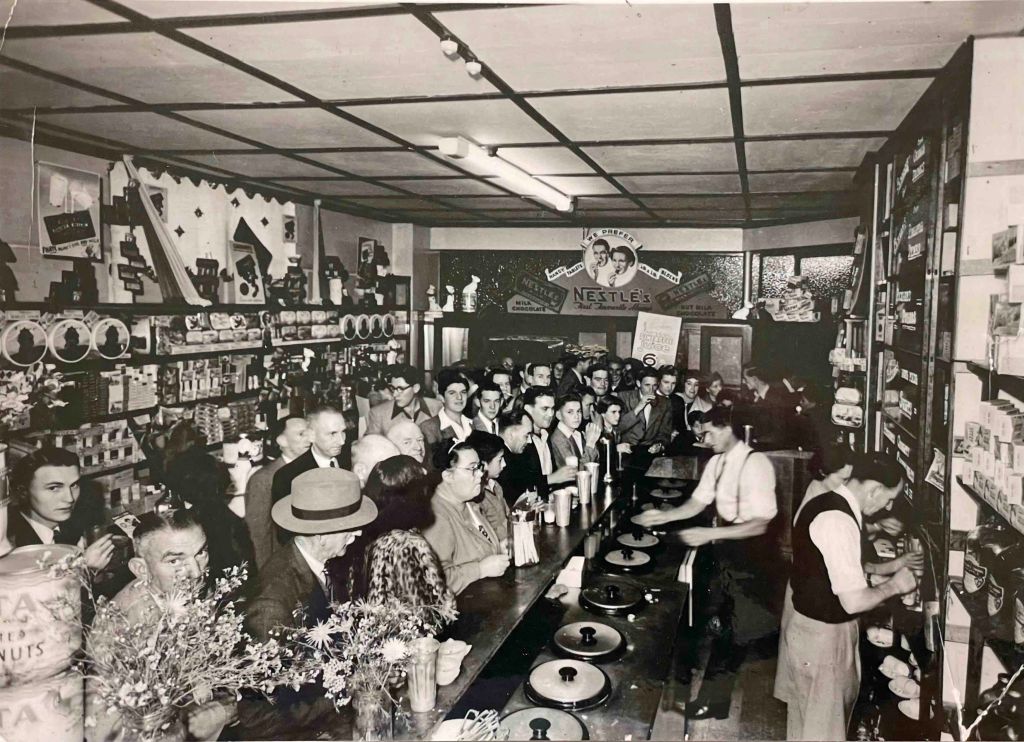
Pickham’s was famous for its freshly squeezed pineapple juice which sold for sixpence a glass. Customers would bring billy cans to fill up with the juice to take home. It was also known for its chocolate dipped ice creams on a stick called polars.

Arthur Pickham later had a news agency at 142 Boundary Street.
The Argyris brothers
The Aroney building is notable for its long tenancies. The four Argyris brothers Dimitri, Theo, Mike and Peter, had their well known tailoring business in the 95 Vulture Street shop from 1979 until 2012. They had immigrated separately from Kalymnos between 1953 and 1964. Dimitri passed away in 2010, and the remaining brothers decided to retire two years later.
The corner shop has been occupied by an optometrist since the early 1990s.
Bent Books
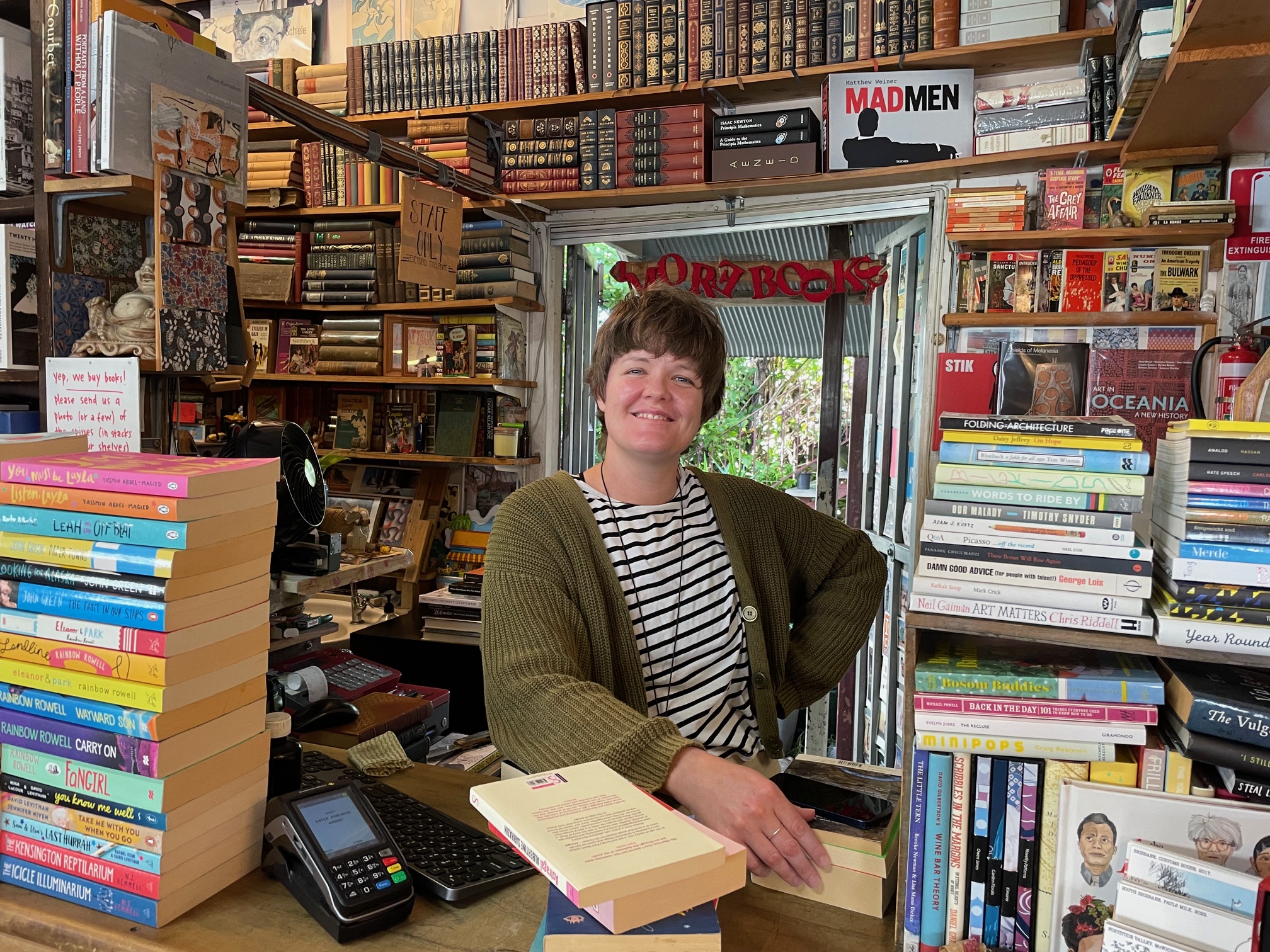
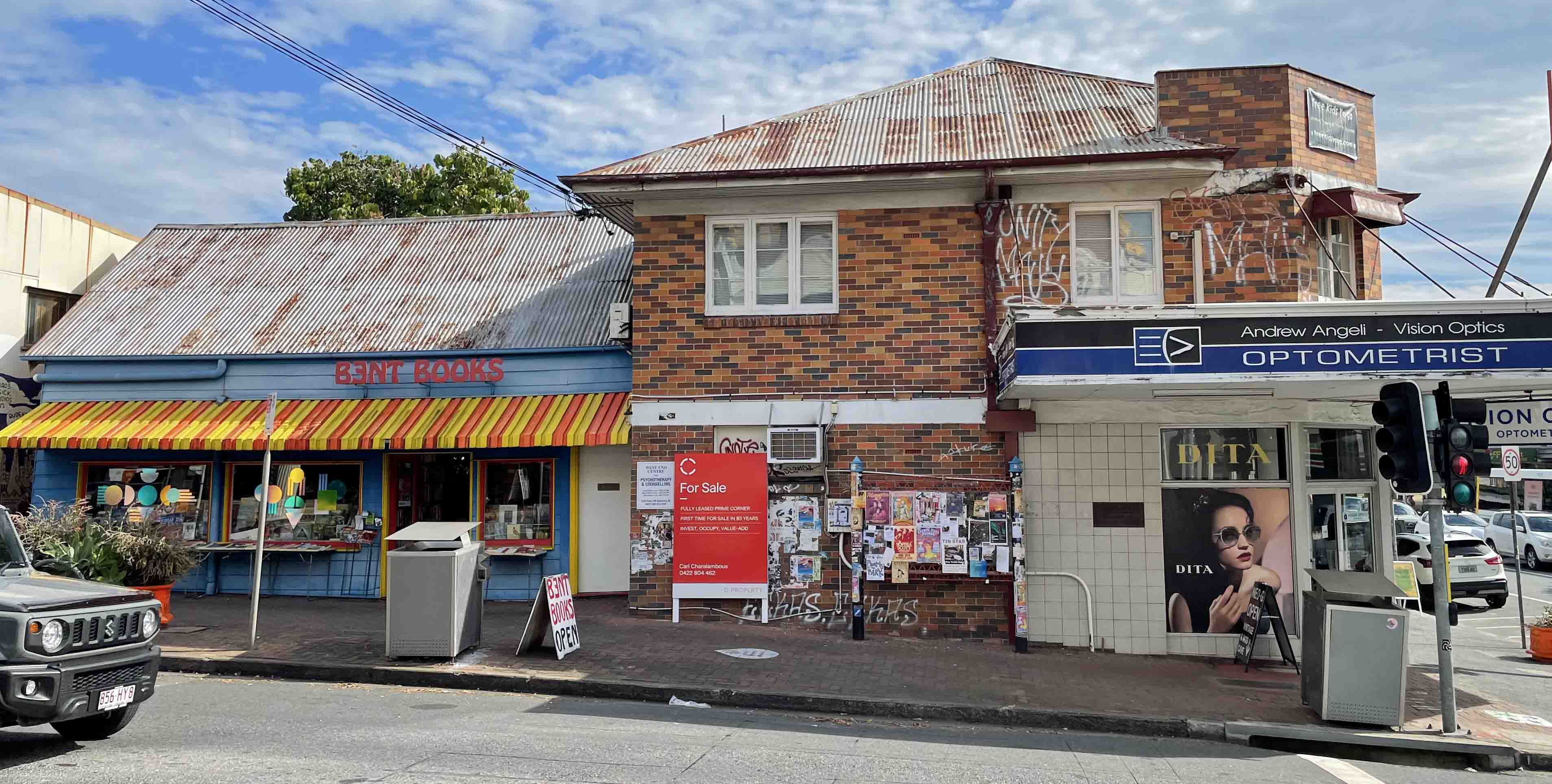
For 28 years, the old confectionary factory annex in Boundary Street has been home to popular Bent Books, and the current owner, Kat Mulheran, has been there since 2001.
The building remained in family hands until its sale in 2024.
156 Boundary Street, the south-east corner
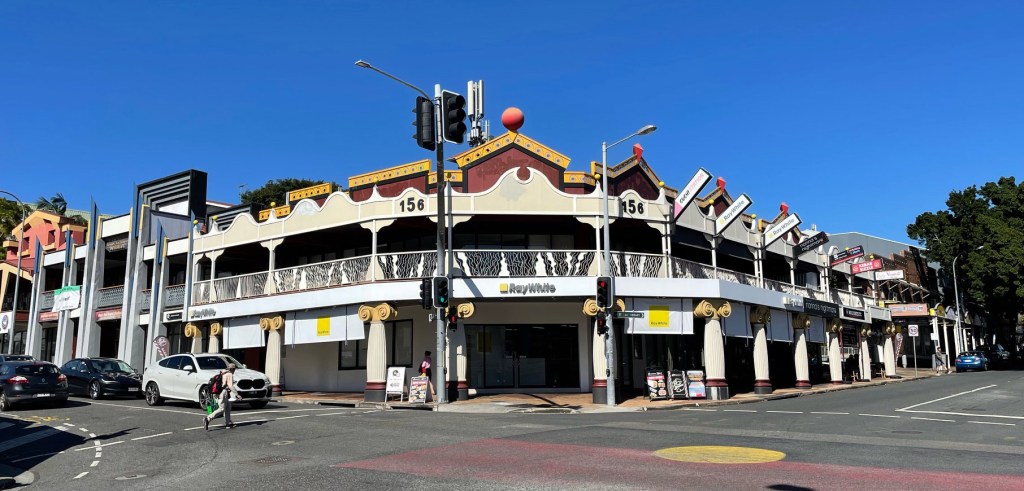
The first mention of a business on this corner is from 1888, when the Royal Bank of Queensland purchased a building on the site after having established a branch here. The West End branch was relocated in 1899 to busier Stanley Street.
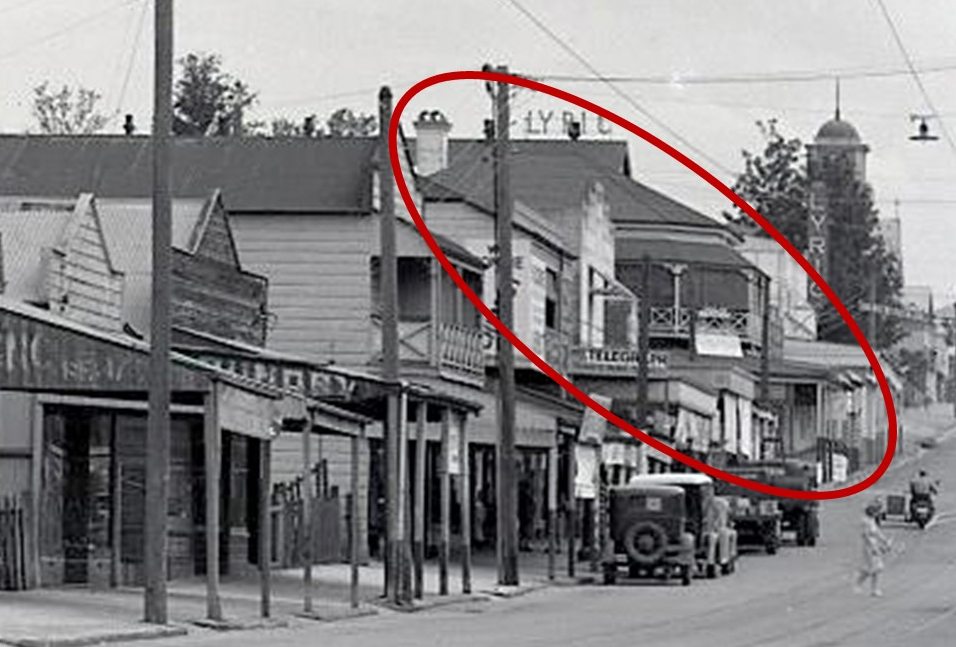
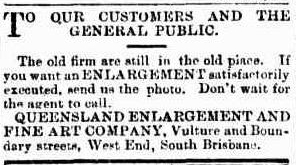
John Lackey, who ran a photo enlarging and framing business, then occupied the building for around 10 years. Lackey made the news when, in 1904, travelling salesman Claude Bowerman pleaded guilty to embezzling £65 from him. Local West End police had travelled to Hong Kong to arrest Bowerman, where one of the constables, suffering from depression, had attempted suicide by cutting his throat.
From then, multiple tenants are mentioned in post office directories. They include hair dressers, a cycle works, a radio store, plumbers, a dressmaker, a furniture store, a pastry cook and the Queensland National Bank.
The old building had been replaced by 1963, when the BCC supermarket moved diagonally across the street from its original location.
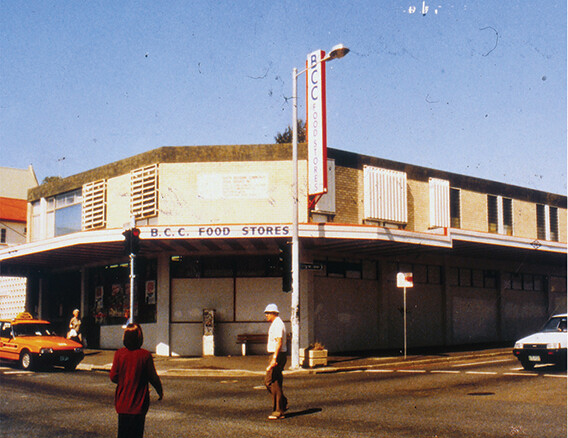
In 1959, the expanding Woolworth’s chain purchased BCC’s 32 stores. They initially continued to trade under their old name, but the BCC brand was slowly withdrawn. In 1995, the last three BCC stores, including West End, were shut.
In 1998, architect Russell Hall designed a building refurbishment. His design, including the use of whimsical ionic columns recalling the strong Greek presence in the area, made the formerly austere building a talking point of West End.
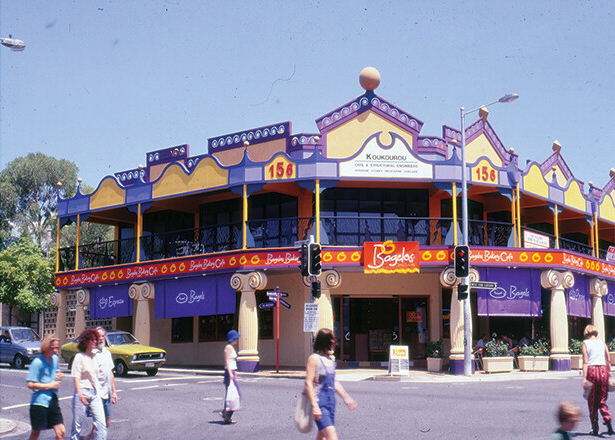
Today
Over 140 years, grocers and fruiterers have given way to convenience stores, tea rooms to coffee shops, and banks have all but disappeared. However, business such as Shay’s Shoes and the corner pharmacy provide a direct link with the past and still form an essential part of our community.
My thanks to Kat at Bent Books for suggesting that I write this post.
References
Most references appear as hot links through the text.
- (1910). Jubilee history of Queensland : a record of political, industrial and social development from the landing of the first explorers to the close of 1909. Brisbane: Diddams (via University of Queensland eSpace)
- Brisbane City Council Heritage Listing 195 Boundary Street, West End.
- Gosseye, J., & Doucet, I. (2024). The Postmodernisms of Russell Hall: Exploring Australia’s Changing Architecture Culture Through a Biographical Approach. Fabrications, 1–34.
- Conomos, D. (2002). The Greeks in Queensland : a history from 1859-1945 / Denis A. Conomos. Copyright Publishing.
- Johnston, W. R. Ross Johnston Greek Emigration Research ca. 1930-1990. Box 17731 State Library of Queensland.
© P. Granville 2024
 Highgate Hill and Its History
I particularly enjoyed the section on “Davies Corner -154 Boundary St” and the information of John Davies and particularly his nephew J.P. Davies (Percy). I have an anecdote which I am certain was correct and that is he liked to refer to himself as “JP before and after” when he became a Justice of the Peace. I was told this several times by my father, Mervyn Jarrott, who was apprenticed to JP to get qualified as a pharmaceutical chemist in Queensland. My father who lived in Highgate Hill was apprenticed to JP from about 1927 to 1932 at the Boundary St shop. I haven’t been able to get the exact dates from the original Pharmacy Board of Queensland but I will keep trying to see their records of registered pharmacists around that era. My father never referred to him as “Percy”- always as “JP”. My father died in 1973 so I cannot confirm the above with him ! bevyn.jarrott@gmail.com
LikeLiked by 1 person
I particularly enjoyed the section on “Davies Corner -154 Boundary St” and the information of John Davies and particularly his nephew J.P. Davies (Percy). I have an anecdote which I am certain was correct and that is he liked to refer to himself as “JP before and after” when he became a Justice of the Peace. I was told this several times by my father Mervyn Jarrott who was apprenticed to JP to get qualified as a pharmaceutical chemist in Queensland. My father who lived in Highgate Hill was apprenticed to JP from about 1927 to 1932. I haven’t been able to get the exact dates from the original Pharmacy Board of Queensland but I will keep trying to see their records of registered pharmacists around that era. My father never referred to him as “Percy”- always as “JP”.
LikeLiked by 1 person
Paul,
Another great read and I well recall the BCC store on the south-east corner plus my mother shopping at a fish monger beside JP Davies Pharmacy, presumably on the site of the original Shay Shoes at # 152 Boundary. However, I didn’t know about Shays at an interim # 120 Boundary location (beside Halls Jewellery) as I only recall meeting Greg Shay when he and Wayne ran their business at #126, this being adjacent to the AHEPA Hall ( possibly a typo??)
As for the Birchely Builiding on the North West Corner I have been in the basement, circa 1990s, and it is quite a rabbit warren … with a low head height and possibly earthen floor??… then being used for storage.
My recollections begin when Tony Pope operated the hardware store, on site, circa 1970s, and I’m not sure if he traded as Price Rite or the earlier Brightways, which you mention, …and here I’m not 100% sure if it was actually a Brightways or Brightlights as there was a famous hardware store in George Street which traded as Brightlights, the name arising from bright electrical lighting on offer.
Tony sold the business and then concentrated on his military history and toy soldier style shop on the Prudential Building corner at Queen and North Quay. Peter Samios had taken over this Price Rite hardware shop before Mitre10 absorbed that group and then Peter rebranded with the launch of the True Value banner.
In the mid to late 1990s Peter and son George sold to Mark Stephan who eventually moved the True Value business to 38 Cordelia Street, approximately 1999/2000 . Thereafter, the Birchley high visibility site was converted into a lingerie boutique trading as Honey Birdette. This entailed a Victoria’s Secret style external identification and was a rather interesting change of use for what had been an otherwise quite staid and conventional retail location. However, this Honey Birdette outlet was short lived and that’s when the ‘brightly lit’ Seven Eleven franchise moved in.
Keep up the brilliant work.
Regards,
John Carson
15/09/24
LikeLiked by 1 person
Hi John,
Thanks very much for your interesting comments. You’re absolutely correct about Shay’s being at 126. I have to admit that I copied some info from a newspaper article without checking the address. You’ve got a great memory – I don’t remember Honey Birdette, possibly because I don’t buy lingerie! The phone books of the period have the hardware store as Brightways, however I believe that the same company used the two different trading names. I also remember that old style hardware store on George Street. Paul
LikeLike
Where the Optometrist is now (on the south west corner) was a corner store selling all sorts of small goods, in the 1970s. The shop was blown up by a bomb in th e 1970s. I saw the explosion as I was heading there to buy lollies. After it was repaired it became the optometrist.
LikeLike
Loved to read the story of west end, spent a lot of my childhood at my Grandmothers house next to the Lyric theatre, my grand father owned the wood yard on the same property, brings back many memories . Russell Hill , Russellhill01@dodo.com.au
LikeLike
Thanks Russel. You might like to read my little history of the Lyric Theatre. https://highgatehill-historical-vignettes.com/2022/04/02/tom-garrick-cinema-pioneer/
LikeLike